

The first week I slept with a pillow between my knees, I still woke up at three in the morning with a stiff neck. The pillow was there. It just was not doing anything. It had slid down toward my ankles sometime around midnight, and my top knee had rolled forward anyway, which is the exact thing it was supposed to prevent. I am 61, I have slept on my left side my whole life, and I spent 30 years leaning over patients in a dental chair, so my right shoulder has opinions about all of this.
What I worked out over eight months with the Contour Legacy Leg and Knee Pillow is that the pillow is maybe half the job. The other half is where you put it, how level it sits, what your bottom leg is doing, and whether your bedding is working against you. Get those four things right and it does what the listing says it does. Get them wrong and you have bought a lump of foam that ends up on the floor by one in the morning. Here is the sequence, in the order I actually worked it out, including the parts that took me longer than they should have.
Eight months in, and it still sleeps between my knees every night
Soft memory foam, 10 inches long and 9.5 inches wide, with a washable cover and a one-year manufacturer warranty. It was the third thing I changed and it is the first thing I would replace if it disappeared.
Amazon Check Today's Price on Amazon →Step 1: Straighten Your Bottom Leg Before You Do Anything Else
Most of us put the pillow between the knees and call it finished. But the bottom leg is the anchor. If your bottom leg is drawn up toward your chest, your pelvis rotates forward and no pillow on earth can put it back. That was my first mistake. I was lying there with my bottom knee up like I was sitting in a lawn chair, and my lower back ached by two in the morning no matter what was between my legs.
Now I straighten that bottom leg almost all the way, with just a small bend at the knee, and let it lie flat on the mattress. That gives the pillow something level to sit against, and it means my hip is not already twisted before I have started. The change in my lower back by the end of that week was more noticeable than anything the pillow itself did.
It took me three tries to get that far. The first was a folded bath towel, which felt like a sensible free experiment and lasted about ninety minutes before it flattened into nothing. The second was a throw pillow off the guest bed, which was too tall and pushed my top knee up toward my chin, and that was worse in a different way. The Contour arrived in the third week of March. The difference was not that it was magic. It was that it was ten inches long and nine and a half wide, long enough to stay put when I shifted, and low enough that my hip did not tilt.
It takes about five nights to stop wanting to curl up. I am not going to pretend it was comfortable on night one. But the curl is what was pressing my right hip into the mattress, and the whole point of this exercise is to stop doing that.
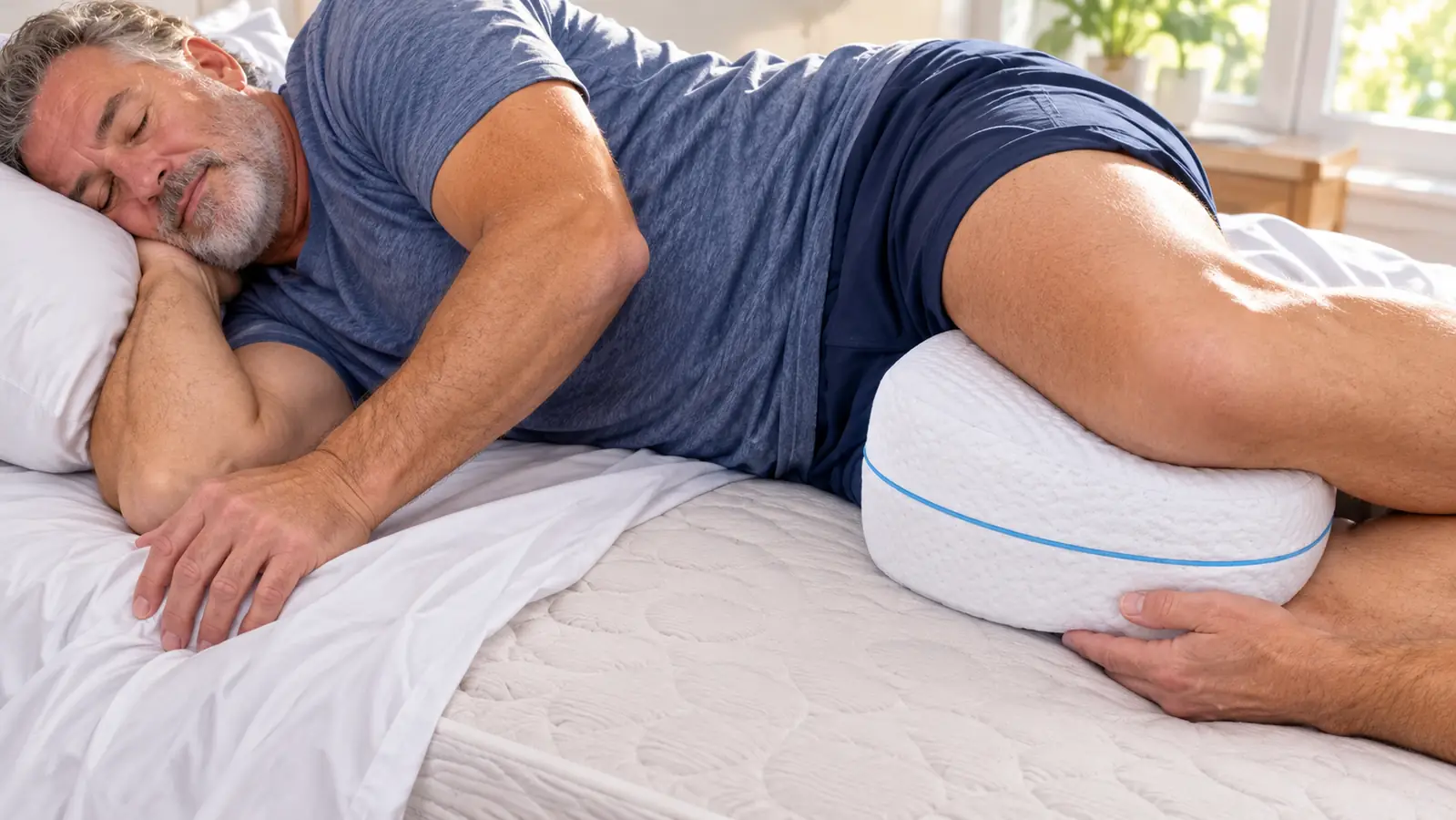
Step 2: Get Your Top Knee Level, Not High
The Contour pillow is memory foam and it is on the soft side. That matters, because soft foam squashes. If your top knee sinks until it is level with the bottom knee, you have recreated the exact position that made your hips ache in the first place, just with foam in the middle of it.
What I check now, every night before I turn the light off, is whether my top knee sits level with my bottom knee or a touch higher. Not stacked so high that my hip tilts up. Level. When it is level, my top hip does not roll forward and my lower back stays quiet through the night.
I got fussy about this in April and actually measured it. I laid a ruler on edge across the mattress and had Dale tell me where the two knees sat, because you cannot see your own knees when you are lying on your side. There was about half an inch between them, top knee slightly higher, and my hip felt square for the first time in a long while. Two weeks earlier he had told me the top knee was sitting an inch below the bottom one and I had argued with him. He was right. If you have somebody in the house who will look, ask them. It is a two-minute conversation that saves you a month.
If your knees are not level, the fix is usually the bed underneath, not the pillow. My queen is nine years old and on the firm side, so the soft foam has something to push against. On a mattress that is already sinking, the pillow will sink with it and you will be back where you started. It is a piece of foam. You work with the bed you have.
Step 3: Stop Your Top Leg From Sliding Forward
This is the part that took me months. The pillow keeps your knees apart. It does not keep your top leg from sliding forward at the hip. Around two or three in the morning I would wake up more or less on my face, with my top knee out in front of my bottom knee and the pillow wedged uselessly behind it.
The night that pushed me over the edge was a hot one in June. I woke at twenty to three with my top knee somewhere up near my navel and the knee pillow shoved down behind my calf, and my right shoulder aching the way it used to ache after a full day of hygiene appointments. I lay there in the dark and did the arithmetic. Eight hours a night, most nights, for years, all of it spent slowly rolling onto my face. The knee pillow had been doing its job the entire time. It just came with a job description I had never read.
About five months ago I added a full body pillow in front of my chest and started hugging the top half of it. That gives my right arm and my sore shoulder somewhere to land instead of rolling forward and dragging the rest of me with it. The knee pillow still does the knee job. The body pillow does the shoulder job. I spent a long time trying to make one pillow do both, and it does not.
You can test this tonight without buying anything. Roll a bath towel into a cylinder and put it where your chest would land if you rolled forward. If you sleep better, you know what to look for. If nothing changes, you have saved yourself the money and the closet space.

Step 4: Plan for the Heat
My bedroom runs warm from June through September. A foam pillow pressed between two legs for seven hours is going to hold heat. Contour uses a temperature regulating foam that pushes heat outward, away from the body, and I would say it is noticeably better than plain foam. It is not air conditioning, and anyone who tells you otherwise sleeps in a colder house than mine.
Two things made the biggest difference for me. First, I stopped tucking the pillow under the sheet. It sits on top, against my legs, in the cover it came with. Second, I wash that cover every couple of weeks, which the care instructions allow and which matters a great deal more in July than in January.
One more thing I tried in August, and I will pass it along because it worked: twenty minutes in the freezer before bed. I did it for a week and slept through the night twice, which was two more times than the week before. It is not elegant. It helped.
Step 5: Give It a Week and Give It a Home
The first three nights were worse than no pillow at all. My hip ached in a new place, my top knee kept losing the pillow, and I woke up at three on schedule. That is normal. You are changing the angle your hips sit at for eight hours a night, and your body has to unlearn something.
I gave it a full week before I decided anything. By night five the pillow was staying put, mostly because I had stopped thrashing and started rolling over in a way that kept it between my legs. By night seven I was waking up less often and going back to sleep faster when I did.
The last piece was giving the pillow a home. During the day mine sits on my side of the bed, propped against the headboard. Not in a drawer, not on the floor. When it is right there at 10:30 at night, I use it. When I was keeping it in the closet, I did not, and then I blamed the pillow.
The knee pillow keeps your knees apart. It does not stop your top leg from sliding forward at the hip. It took me five months and a second pillow to learn the difference.
What Else Helps
The knee pillow was the third thing I changed, not the first. First was a two inch gel memory foam topper on the queen, about eleven months ago, which stopped my hip and shoulder from pressing straight into a firm nine-year-old mattress. Second was a curved head pillow, about nine months ago, that arrived too firm and got about two handfuls of fill taken out over two weeks until the height matched my shoulder. Fourth, four months ago, was a contoured sleep mask, because the sun comes through the east window before six and Dale reads with his lamp on later than I do.
There is an order to this that I did not know when I started, and if I were doing it over today I would go in this sequence: the knee pillow first, because it is the cheapest and the fastest to judge, then the topper, then the head pillow, then the mask. I did it backwards. I started with the topper and spent the first three months assuming it had not worked, when in fact my hips were still rotating forward every night because nothing was holding my knees apart. The topper was doing its job the whole time. I just had not given it any help.
None of that is required to make a knee pillow work. But if you are fighting a mattress past its prime and a head pillow at the wrong height, you will blame the knee pillow for a problem it did not cause. The knee pillow is the simplest of all these changes, which is why it is worth trying early. It just cannot outwork a bad bed.
Who This Is Not For
If you sleep on your back or your stomach, skip all of this. A knee pillow is for people whose top knee drops forward and drags the hip with it, and that only happens on your side. If you cannot sleep with anything between your legs because it feels like a foreign object, this will not be the thing that converts you. And if your mattress is fifteen years old and has a body-shaped dip in it, the pillow will follow the dip and you will spend eight months writing notes about it the way I did, for nothing.
If your hips ache where they press into the mattress, start here
Soft memory foam, 10 inches by 9.5 inches, a washable cover, and a one-year manufacturer warranty. Mine has been between my knees every night for eight months, and it is still the cheapest change on my list.
Amazon Check Today's Price on Amazon →