

Nine months ago I bought a pillow I could take apart. That is the short version. The longer version starts at 3 a.m., which is the hour I used to wake up with a stiff neck and a right shoulder that felt like somebody had been standing on it.
I am 61, a retired dental hygienist in Columbia, Missouri, and I have slept on my left side since I was a girl. Twenty-nine years of leaning over patients did the right shoulder no favors, and by my late fifties the ache had moved into my hips as well, right where they pressed into the mattress. I went through the usual rotation. A flat pillow that went pancake-flat by February. A molded memory foam brick that was too tall and left my ear ringing. A down alternative I had to re-fluff every night like a campfire. The Sidney Sleep Adjustable Curved Pillow is the one that stayed on my side of the bed. Not because it was perfect on day one, because it was not. Because I could change it.
The Quick Verdict
Buy it if you sleep on your side and you are willing to spend two weeks pulling fill out until the height matches your shoulder. Skip it if you want a pillow that is finished the moment you unwrap it.
Amazon Check Today's Price →The first pillow I could actually adjust
Shredded fill you add or remove, a contoured curve for head and shoulder support, queen size at 19 by 29 inches, with extra fill and a storage bag in the box. Nine months in, it is still the only head pillow on my side of the bed.
Amazon Check Today's Price on Amazon →How I've Used It
The pillow arrived about nine months ago, in late winter, and it came out of the box firm. Firmer than I expected. I gave it one night as it was and woke up with my chin pushed up and my neck complaining about it.
So I did what the listing suggests and took fill out. About two handfuls over the first two weeks, a little at a time, testing for two or three nights between adjustments. I am not a person who enjoys fiddling with things, so the fact that I kept at it says something. Somewhere around night twelve the height matched my shoulder and I stopped thinking about the pillow at all. That is the goal, as far as I am concerned. You should not be thinking about your pillow at 3 a.m.
The spare fill went into the storage bag that came with it, and the bag lives on the hall closet shelf next to the extra blankets. The pillow itself has not moved off my side of the bed since. Dale, my husband, is a back sleeper and a mild snorer. He tried it once, declared it too much pillow, and went back to his own. That is fine. It is a queen at 19 by 29 inches, which is plenty of pillow for one person and a lot of pillow for two people to split.
I should be honest that this is one part of a setup rather than the whole of it. About eleven months ago I put a two inch gel memory foam topper on the mattress, so my shoulder and hip are not pressing straight into a nine year old firm queen. A contour knee pillow came along about a month after the Sidney Sleep pillow, and it keeps my top hip from rolling forward. A body pillow joined the bed in early summer for my right arm. The head pillow does one job and does it well, but I would be lying if I said it did all the work on its own.
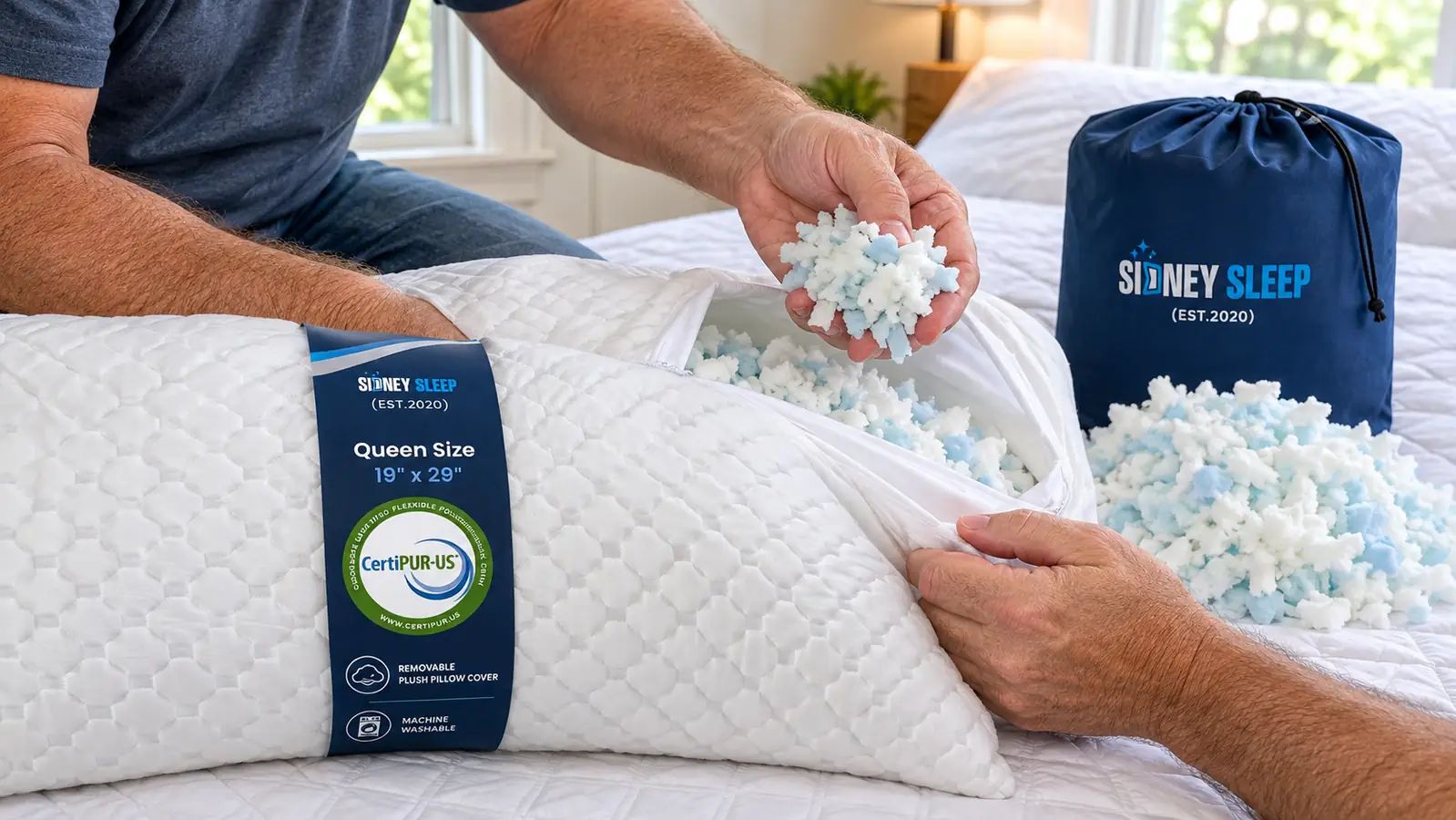
The Fill Is the Whole Point
A pillow is either adjustable or it is not, and almost all of them are not. The Sidney Sleep is shredded fill rather than a molded block, which means it arrives less as a finished object and more as a starting point. You add fill or you take it out and the height changes with it.
What that bought me was a number I could not have guessed on my own. I needed less height than I assumed, but I needed it in a specific place: under the neck, with a small dip where my ear lands. The curved shape handles part of that. The fill handles the rest. What I liked is that the two adjustments stayed separate. The curve is fixed; the height is not. When my shoulder was cranky in the spring, I took out a little more fill. When the weather turned and the bedroom got warm and the bed felt softer under me, I put a handful back in.
There is a version of this review where I tell you the pillow solved a problem. It did not. It removed a nightly irritation, which is different and honestly more useful. I still wake up sometimes. I still have a right shoulder that reminds me I spent 29 years leaning over people. But I am not waking at 3 a.m. with a locked neck, and my hips are not aching where they meet the mattress. That is a fair trade for a pillow.
What Changed After the First Two Weeks
Those first two weeks were not good. I want to be straight about that, because most reviews skip it. Any shredded fill pillow needs a break-in period, partly because the fill compresses under a head and partly because you are still learning how much fill you actually want. The Sidney Sleep was firm out of the box and stayed firm for the better part of a week.
By week three the shape had settled and I noticed it in small ways. I stopped punching it down in the night. I stopped flipping it over looking for a cooler patch. I stopped waking up to rearrange things and started waking up because it was morning. Nine months in, it has held its shape well enough that the fill still in the closet has gone mostly untouched, apart from that one handful I put back in the spring.
The curve itself does what a contour pillow is meant to do. It takes some of the weight off the ear and jaw and gives the neck something to rest against instead of something to hang from. My ear does not go numb the way it did on a flat pillow. The trade is that the pillow has a right way and a wrong way. Roll onto your back in the night and the curve is suddenly in the wrong spot, and you notice it. I noticed it far more in the first month than I do now.
Where It Falls Short
It sleeps warmer than a flat pillow. I will not pretend otherwise. Shredded foam holds heat, our bedroom runs warm from June through September, and this is a split-level house with one window unit doing its level best. I turn the pillow over in the summer, which buys me an hour or so before it warms up again.
The break-in period is real and it asks something of you. If you are the sort of person who wants a pillow to be correct on night one, this one will feel like homework. Two handfuls of fill is not a minor adjustment, and it took me a couple of weeks of paying attention to get there. I do not regret the two weeks. I would not want to repeat them.
And then there is the shape, which is a commitment. Contour works if you stay on your side. If you move around a great deal at night, or if you spend half of it on your back, you will spend some of the night working against it. It is also a queen at 19 by 29 inches and it is heavy once it is full of fill, so it does not travel well. Mine stays home.

Sleeping Next to Someone Who Does Not Use One
Dale is 63, a retired mail carrier, and he has slept on his back for as long as I have known him. He took one look at the curved shape and said it looked like something from a dentist's office, which from a man who spent thirty years walking a route is high comedy. He tried it for one night. He said it pushed his head forward and he could not get his chin out of the way.
That is the useful part of the story for anyone shopping for two. This is not a sharing pillow. It is a side sleeper's shape and it does nothing for a back sleeper. It is wide enough that it takes up a real share of a queen when it sits square in the middle, so we ended up with his pillow on his half and mine angled slightly toward the edge. If you and your partner both sleep on your sides, you will want two. If you sleep differently, one is enough and the other person will be perfectly happy with whatever they already have.
What I Tried Before This
Before the Sidney Sleep pillow I went through three others in about two years. A flat standard pillow that was fine for a month and then flattened. A molded memory foam contour that was the right height but too hard, so my ear hurt by morning. A down alternative that I liked for two weeks and then had to fluff every single night like I was tending a fire.
The difference with this one is not that it is softer or better made than the others. It is that when it was wrong, I could fix it. That sounds like a small thing. It is the whole thing. A pillow you cannot adjust is a guess you live with. A pillow you can adjust is a guess you correct.
I also want to be clear that I did not buy a new mattress over any of this. The queen is nine years old and on the firm side and it is going to stay that way for a while yet. The topper and the pillows did the work a new mattress would have done, for a fraction of the disruption, and I did not have to sleep in the guest room for a week while a delivery truck came and went.
What I Liked
- Shredded fill you can add or remove, so the height matches your shoulder instead of the other way around
- Contoured curve takes weight off the ear and jaw for side sleepers
- Extra fill and a storage bag are included, so nothing has to be improvised
- Queen size at 19 by 29 inches, with room for a side sleeper to settle in
- Held its shape through nine months of nightly use
Where It Falls Short
- Firm out of the box, and it needs about two weeks of fill adjustment before it feels right
- Sleeps warmer than a flat pillow, which is noticeable in summer
- The curve is a fixed shape, so back sleepers and restless movers fight it
- Heavy once it is full of fill, and it does not pack well for travel
A pillow you cannot adjust is a guess you live with. A pillow you can adjust is a guess you correct.
Who This Is For
Side sleepers with a sore shoulder or a stiff neck, who are willing to spend two weeks tuning the fill until it sits right. People who sleep on the same side most nights and want the support under the neck rather than under the head. Anyone whose mattress is on the firm side and who feels that firmness in the shoulder and hip by morning. If you have a queen and one half of it is yours, 19 by 29 inches is generous without being in the way. It also suits people who do not want to be shopping for another pillow next year. Nine months in, mine is fine, and the spare fill is still in the closet.
Who Should Skip It
If you sleep on your back, the curve will land in the wrong place and you will get nothing out of it. Dale is my evidence. If you want a pillow that is right the night you open it, two weeks of pulling foam out will annoy you more than the pillow helps you. If you run hot, shredded fill holds warmth and you will feel it in July and August. And if a contoured shape sounds like a hassle rather than a support, trust that instinct. A flat pillow you never think about beats a shaped pillow you fight every night.
If your shoulder is the thing waking you up at 3 a.m.
I took out about two handfuls of fill over two weeks and stopped waking with a locked neck. That is the whole review. Everything above it is detail.
Amazon Check Today's Price on Amazon →