

Eight months ago I was waking up at 3 a.m. most nights with a stiff neck and a dull ache in both hips where they pressed into the mattress. I am 61. I have slept on my left side my whole adult life, and after 35 years of leaning over patients in a dental chair, my right shoulder had strong opinions about all of it. I had already tried the obvious things. A second bed pillow between my knees slid out and landed on the floor by midnight. A folded blanket went flat inside a week. A rolled towel worked for about four nights and then I got tired of re-rolling it. What has actually held up is a small contoured foam pillow from Contour, the Legacy Leg and Knee Pillow, and it has been between my knees every single night since late March.
This is not a dramatic story. Nothing about a knee pillow is dramatic. But it is the piece of my sleep setup that I stopped thinking about first, and after eight months of nightly use I have a pretty clear picture of what it does, what it does not do, and who it is probably wrong for. I will give you the short version up front and then the long version, including the two things I would change.
The Quick Verdict
It does one narrow job very well: it keeps my top knee and hip from rolling forward, night after night. It will not fix a bad mattress and it will not replace a body pillow for your shoulders.
Amazon Check Today's Price →Eight Months In, It Is Still Between My Knees Every Night
A small memory foam leg pillow, 10 by 9.5 inches, and it has outlasted every folded blanket and spare bed pillow I tried before it. Current price is on the listing.
Amazon Check Today's Price on Amazon →How I've Used It
I bought the Contour Legacy about eight months ago, in late March, after a stretch where I was waking two or three times a night. It goes between my knees every night. In the daytime it sits on my side of the bed against the headboard, which sounds like a small thing until you have spent five minutes at 10 p.m. patting around under the covers for a pillow that has migrated.
The specs, for what they are worth: memory foam fill, a soft firmness rating, a fabric that is 62 percent polyester and 38 percent lyocell, and a footprint of 10 inches by 9.5 inches. It weighs just under seven ounces. That last number matters more than it sounds. A heavy pillow drags the sheet down with it and wakes you when it shifts. This one does not.
My bed is a queen, about nine years old, and on the firm side. My husband Dale sleeps on his back and snores a little, so I am not a light sleeper by accident. I am a light sleeper by marriage. The knee pillow has not changed his snoring and it was never going to. What it changed is how much of the night I spend with my top leg rolled forward and my hip twisted.
For context, because I think it matters: the knee pillow was not my first purchase. I had already put a two inch gel memory foam topper on the mattress, and I had already replaced my head pillow with an adjustable one. Those came first. I say that because it would be dishonest to hand this pillow all the credit. It did its job on a bed that had already been made a little softer underneath me.
Dale has never used it and has no interest in it. He sleeps on his back, and a pillow between the knees is a solution to a problem he does not have. It stays on my side of the bed, which is fine, because it is small enough not to crowd a queen mattress shared with a man who spreads out.
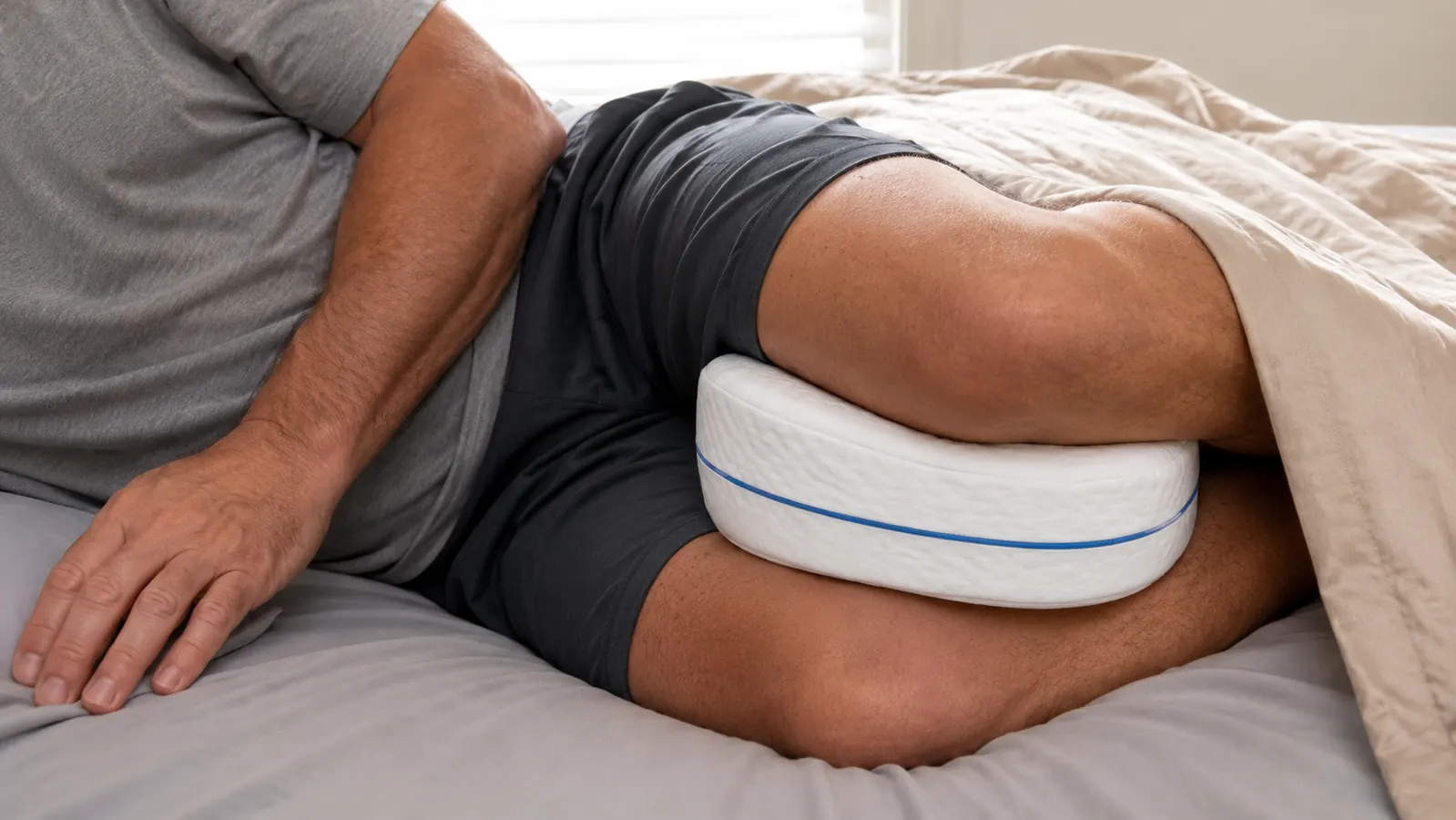
What the Contour Legacy Actually Does
The mechanism is not complicated. When you sleep on your side, your top leg wants to slide forward and down. Your top knee settles onto your bottom knee, your hip rotates, and your lower back spends six hours in a twist it was not built for. That is where the 3 a.m. ache comes from. The fix is to hold the top leg roughly level with the bottom one. Anything between the knees does that for a few hours. Something that stays put does it all night.
The Contour pillow has a shaped surface rather than a flat rectangle, so it cradles the top knee and the space between the legs instead of just wedging in there. In eight months it has not ended up on the floor once. That is the whole review, honestly. Everything after this is detail.
I considered three other options before this one. A knee wedge, the kind shaped like a triangle, which felt like sleeping with a book between my legs. A strap style pillow, which held its position but felt confining against my skin. And simply using my body pillow for both jobs, which does not work because it is far too wide to sit comfortably between the knees. The Contour Legacy is the middle option: shaped enough to stay, small enough to forget.
What it does not do: it does not support your shoulders, it does not stop you from rolling onto your back at 4 a.m., and it does not make a nine year old mattress feel new. If your neck is the problem, this is the wrong pillow and you should look at your head pillow instead. If your hips and lower back are the problem when you get up, this is aimed squarely at you.
The First Two Weeks
The first night felt strange. There is a lump between your knees where there was not one before, and your legs have to learn a new resting position. I gave it four nights before I decided anything. By the third night I had stopped noticing it was there, which is the goal with any sleep gear.
There was no break-in period the way there was with my head pillow, where I spent two weeks pulling out handfuls of foam. The Contour Legacy is soft to begin with and stayed soft. I did not have to remove fill, add fill, or wait for anything to compress. If you want a firm, hard block between your knees, this is not that.
The one adjustment was sheet related. The pillow has some grip on the fitted sheet, and in the first week it pulled a corner loose twice. Now I lay it on top of the sheet rather than wedging it down against the mattress, and the problem went away. Small thing, but if you are particular about your sheets, expect it.
By the end of two weeks it was routine. Up at 6:15, pillow back against the headboard, sheets straightened. I mention the routine part because the first few nights are not the test. The test is whether you are still reaching for it in week six. I was, and I still am.
Heat, Firmness, and a Bedroom That Runs Warm
Our main bedroom is on the second level of a split level house and it runs warm from June through September. I am the person who kicks a leg out from under the covers at 2 a.m. So I was ready to resent a foam pillow.
Contour lists a temperature regulating foam that pushes heat outward, away from the body. I am not going to pretend I can measure that. What I can tell you is that after eight months, including a full Missouri summer, I have never once woken up because the pillow between my knees was hot. The place where it touches is not the place that overheats. That is my whole heat review, and I think it is the honest one.
If you sleep hot in general, the bigger variable is your mattress and your bedding, not this. A foam topper under a synthetic sheet will trap far more heat than a seven ounce pillow ever could.
Firmness is the real trade-off. The listing calls it soft and that is accurate. It holds the knee without pressing on it. The downside is that if you are used to a firm foam wedge, or you want something rigid to brace against, this will feel underbuilt. It is a comfort pillow. It is not an orthopedic device and it was not sold as one.
I also wash it less often than I should. It is listed as washable, and I have run it through a cold cycle and let it air dry, but it takes most of a day to dry flat, so it is a weekend job rather than a Tuesday one. If you are the kind of person who wants to throw everything in the dryer, plan around that.

How It Fits With Everything Else on My Side of the Bed
The topper softened the mattress under my hip and shoulder. The adjustable head pillow fixed the height under my neck. Those two were already in place when the Contour Legacy arrived, which means I cannot honestly tell you it would have done the same job on a bare, unmodified firm mattress. What I can tell you is that it works alongside them without competing.
The body pillow I hug in front of my chest handles my right arm and shoulder, the one that got sore from years of leaning over patients. The knee pillow handles the knees and the hip. They do different jobs and I would not give up either one. People sometimes ask whether a body pillow makes a knee pillow redundant. In my case it is the opposite. The body pillow is too bulky to do anything useful between my knees.
It is also small enough to travel with, which I did not expect to care about. It goes in a duffel next to a pair of shoes and adds almost nothing to the bag. The first time I forgot it on a trip to my sister's house, I noticed by the second night.
What I'd Change
Two things. First, one pillow means one position. If I roll onto my right side I have to move it, and at 3 a.m. I sometimes do not bother. A shape or a strap that survived a full roll would be better. Second, the drying time. The one year manufacturer warranty is generous and the fabric has held up through repeated washing, but a day of flat drying is a long time for something you use every night.
One more note on durability, since eight months is long enough to see something. The foam has not gone flat in the middle, the fabric has not pilled, and the shape has held. It looks like a pillow that has been used every night for eight months, and not much worse than that.
Those are small complaints about a small pillow. Neither has made me stop using it, and I would buy it again tomorrow.
What I Liked
- Stays between the knees all night without sliding out
- Soft memory foam with no break-in period and no fill to adjust
- Just under seven ounces and 10 by 9.5 inches, so it packs easily
- Has never felt hot, even through a Missouri summer
- Washable fabric and a one year manufacturer warranty
Where It Falls Short
- Soft firmness will feel underbuilt if you want something rigid
- Only helps while you stay on one side; rolling over means repositioning
- Takes most of a day to air dry after washing
- Does nothing for your neck or shoulders
In eight months it has not ended up on the floor once. That is the whole review, honestly.
Who This Is For
Side sleepers whose hips and lower back ache in the morning and who have already ruled out the mattress as the only cause. People who have tried a spare bed pillow between the knees and gotten tired of fishing it off the floor at 2 a.m. Anyone who wants a small addition to a setup they have already partly built, rather than a whole new system.
It also suits anyone who sleeps warm. That was my biggest worry going in and it turned out to be nothing. And it suits anyone who shares a bed with a partner and does not want another full sized pillow taking up half of it.
Who Should Skip It
Back sleepers. It has no job to do. People who want a firm, rigid brace, because the soft foam will disappoint you and you will end up returning it. Anyone whose only complaint is neck or shoulder pain, since a knee pillow does nothing above the waist. And anyone hoping this will stand in for replacing a mattress that has given up, which is not something a seven ounce piece of foam can do.
If you are on the fence, the cheaper test is a folded towel for a week. If a towel between your knees takes the edge off your hip, the Contour Legacy will do it better and for longer. If the towel does nothing at all, save your money.
The Cheapest Piece of My Setup, and the One My Hips Noticed
Eight months of nightly use and it is still the first thing I put in place before I turn off the lamp. Current price and the full listing details are here.
Amazon Check Today's Price on Amazon →