

Nine years on a firm queen mattress taught me that a pillow between the knees is not a comfort trick. It is the difference between waking at 3 a.m. with hips that ache and sleeping through until Dale's alarm goes off. I am Corinne, 61, a retired dental hygienist in Columbia, Missouri, and I have done this both ways: a regular bed pillow bunched between my knees for years, and since roughly eight months ago, the Contour Legacy Leg & Knee Pillow.
Short answer: the Contour Legacy is the better tool for this one job, and it is the one still on my bed. But a regular bed pillow honestly wins three rows in the table below, and if your knee discomfort is mild you may not need to buy anything at all. Here is the comparison, row by row, from someone who slept on both.
| Contour Legacy Leg & Knee Pillow | A regular bed pillow | |
|---|---|---|
| Holds the top knee in place all night | Memory foam rated soft, shaped to keep the gap steady from lights out to morning | Works well for the first hour, then compresses or slides |
| Supports both legs at once | Built to support both legs and knees together | Supports whichever part of you it happens to be under |
| Stays where you put it | About 10 inches long and 9.5 inches wide, small enough not to migrate | Big and soft, drifts toward the middle of the bed |
| Heat | Temperature regulating foam is designed to push heat outward instead of holding it | Cotton breathes, but a bunched pillow traps heat in its own folds |
| Adjustability | One shape, one softness | Fold it, double it, flatten it, reshape it mid-night |
| Learning curve | Took me four or five nights to stop fidgeting with it | None. Wedge it and you are done |
| Washing | Washable cover, 62 percent polyester and 38 percent lyocell | Goes in the machine with the rest of the bedding |
| Cost of trying it | One purchase, one more object on the bed | You already own it |
| Warranty | One year manufacturer warranty | Whatever the pillow came with, long forgotten |
| Travel | Small enough to pack for a week away | Nobody packs a bed pillow |
What a Pillow Between the Knees Is Actually Doing
Here is what happens when you sleep on your side. Your top leg does not stay stacked neatly on the bottom one. It slides forward, the knee drops toward the mattress, and the hip rotates with it. Contour describes the problem the same way in their own listing: the top leg drops in front of you, pressure lands on your back, the hip joints twist, and the knees touch. I spent years in that exact position without knowing it had a name.
I worked thirty years as a dental hygienist, leaning over patients with my right shoulder rolled forward. By the time I retired, that shoulder had opinions about how I slept. On my left side, the right shoulder had nowhere to go but down and forward, and my hips ached where they pressed into the mattress. The mattress was not the villain. Nine years old, firm, perfectly fine. The problem was the geometry of the position I slept in.
A regular bed pillow between the knees is the obvious first move, and it is what I did for years. You fold it in half, wedge the fold between your knees, and it works. For about an hour. Then the fill compresses under the weight of the top leg, the pillow slides toward the middle of the bed, or you roll over and it ends up behind your back. I would wake at 2 or 3 in the morning, fish it out from under the duvet, refold it, and start over. That refolding is the whole reason I went looking for something else.
Before I bought anything, I tried the free versions, because I am married to a man who thinks a pillow is a pillow. One night I rolled a bath towel into a cylinder and wedged that between my knees. It lasted two nights. By 4 a.m. the towel had gone hard as a rope and left a crease down the inside of my knee. Then I tried two bed pillows stacked on top of each other, which pushed my top knee too high and put a brand new ache in my lower back. Then I went back to one folded pillow and told myself it was fine. It was fine for about a year.
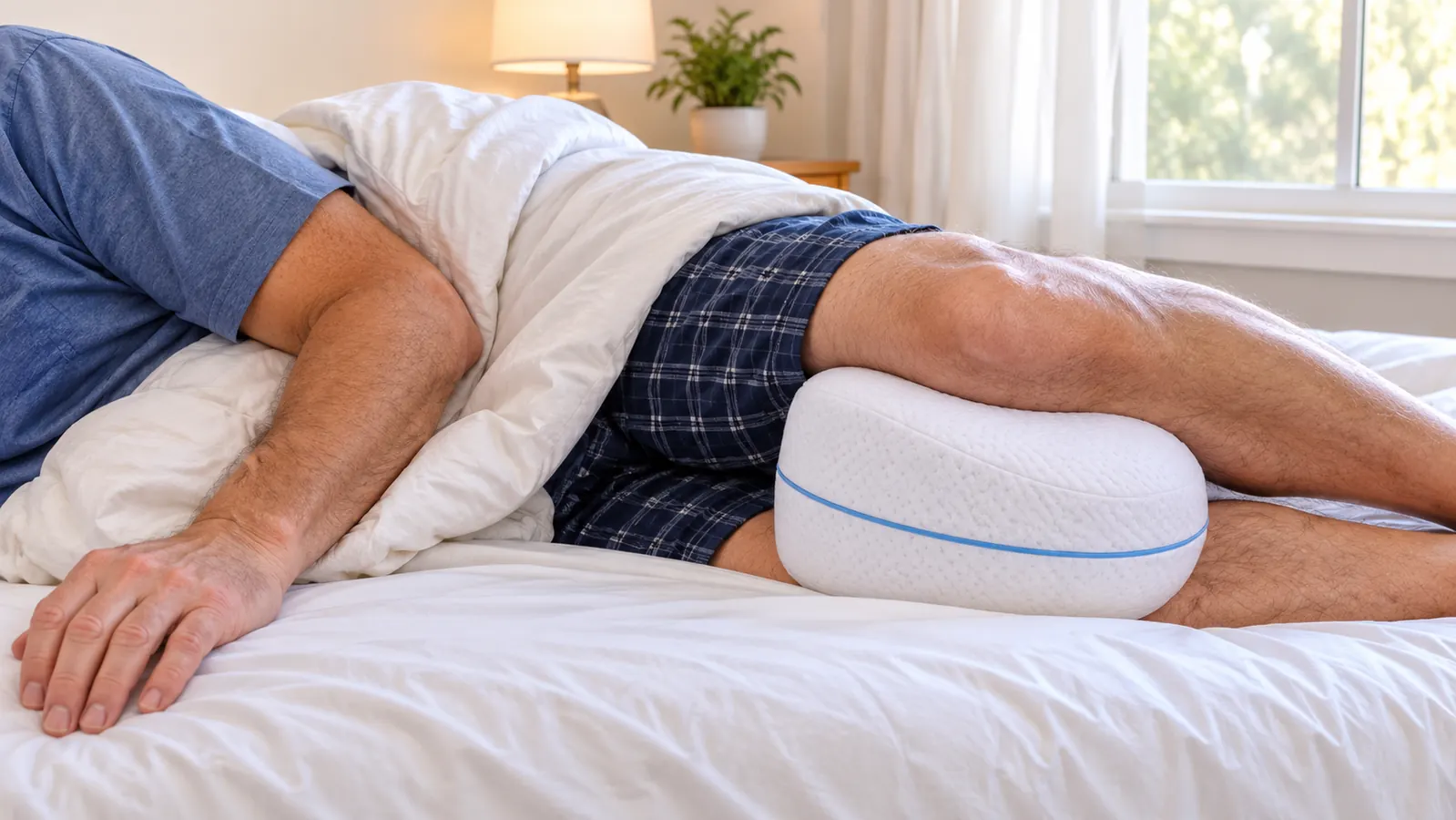
How I Compared Them
I did not run a study. I slept. For years I used a folded bed pillow, the same kind that is on almost every bed in America, and I judged it on one thing: whether I woke up at 3 a.m. with my hips aching and the pillow somewhere it should not be. The answer was usually yes, and occasionally no, which is the frustrating part about a soft pillow. It half works, often enough to keep you trying.
Then about eight months ago I started sleeping with the Contour Legacy between my knees every single night, on the same mattress, with the same husband snoring gently on his back beside me. Same bedroom that runs warm in July. The only thing that changed was the thing between my knees. That is the cleanest comparison I can offer you, and it is why I trust my own notes more than a spec sheet.
I did keep a notebook on the nightstand for the first three weeks, which sounds fussier than it was. Each morning I wrote one line: the time I woke, whether the pillow was still between my knees, and whether my hip felt stiff when I swung my legs out. Of the first twenty-one nights, I woke before 5 a.m. on nine of them, and on six of those the pillow was exactly where I had left it. With the folded bed pillow I kept no notebook, but I remember the shape of those nights well enough: up at least twice, refolding both times.
Where the Contour Legacy Wins
The Contour Legacy is not a bed pillow that got reassigned. It is a leg pillow built for this one job, and the difference shows up around hour three, which is exactly when a folded bed pillow quits. The fill is memory foam with a soft rating, so it holds the gap between your knees instead of collapsing into it. The first night I used it, my top knee stayed where I put it and my hip did not roll forward. I noticed because nothing woke me up.
The size matters more than I expected. It is about 10 inches long and 9.5 inches wide, small enough that it does not crowd the bed and light enough that I can move it with one hand when I turn over. It stays put because it is not fighting a big soft mass of its own. The cover is 62 percent polyester and 38 percent lyocell and it is washable, and the listing says the temperature regulating foam is designed to push heat outward rather than hold it against your skin. My bedroom runs warm from June through September, so I paid attention to that claim and it has held up. Contour backs the pillow with a one year manufacturer warranty, and it carries a 4.3 star average across more than 44,000 reviews, which is the kind of number that comes from people who kept using a thing rather than people who unwrapped it once.

Where a Regular Bed Pillow Wins
Now the honest part. A regular bed pillow is more adjustable than the Contour will ever be. If I want more lift under the knee and less under the thigh, I fold the bed pillow into whatever shape the night requires. Too tall, I flatten it. Too low, I double it. The Contour gives me one shape and one softness, and on the nights my hip is cranky I sometimes want a height it does not offer. There is also no learning curve with a bed pillow. You wedge it and you are done, while the Contour took me four or five nights to stop fiddling with the placement.
Fair is fair about the height question, though. There are nights when my hip is cranky and I want more lift than the Contour offers in its one shape. On those nights I slide the folded edge of my old bed pillow underneath it and use the two together, which is probably not what anyone intended but it works well enough. A bed pillow also does double duty. It is the thing behind my head while I read in bed, and the thing I shove under my arm when I am propped up on a Sunday morning. The Contour does one job and does not pretend otherwise.
And then the obvious one: the bed pillow is already on your bed. There is nothing to buy, nothing to store, and nothing to explain to your husband when a second pillow appears on your side. If your knees ache only occasionally, or if you are not sure this is even your problem, start with the pillow you already own and give it two solid weeks. I would rather you spend nothing and learn something than buy a pillow on my say so. I do travel with the Contour now, because I am not packing a bed pillow in a suitcase for a week in Branson.
Hold the gap from lights out until morning, not just for the first hour
The Contour Legacy Leg & Knee Pillow is memory foam with a soft feel, a washable cover, and a one year manufacturer warranty. It carries a 4.3 star average across more than 44,000 reviews from side sleepers doing exactly the math you are doing right now.
Amazon Check Today's Price on Amazon →Eight Months In, What Actually Changed
I have slept on the Contour Legacy for about eight months now, since late March. It goes between my knees every night. During the day it sits against the headboard on my side of the bed, which is where I find it at 10 p.m. without looking. The cover has been through the wash more times than I can count and the foam has not gone soft or lumpy. That is the part I did not expect. Cheap foam gives up in a season. This has not.
The cover has held through the wash and the foam has not picked up that faint sour smell cheap foam gets after a hot Missouri summer. Dale sat on it twice, once by accident while he was making the bed and once on purpose to see what I had been going on about, and it came back to its shape both times without a crease. I have not had to replace it, and at eight months it still looks like the day I unwrapped it.
The knee pillow is one piece of a setup, and I want to be straight about that. Eleven months ago I put a two inch gel memory foam topper on the queen, under the fitted sheet, and that took the pressure off my hip and shoulder where they met the mattress. Nine months ago I switched my head pillow after pulling handfuls of fill out of it to get the height right. Five months ago I added a body pillow in front of my chest so my right arm has somewhere to rest instead of rolling forward. The knee pillow did the one job none of the others could do, which is keep my top leg from rolling forward in the first place.
That is the test I use now. Not whether a thing feels good on the first night, but whether I stop noticing it. The regular bed pillow never got there. I was always aware of it, always adjusting, always half awake at 2 a.m. fixing the fold. The Contour disappeared from my awareness somewhere in the second week, and it has stayed disappeared.
A folded bed pillow held my knees apart for about an hour. The Contour held them apart until morning, and that gap is the entire argument.
Who Should Buy Which
Buy the Contour Legacy if you already recognize the shape of this problem. You wake with an ache on the outside of your hip. Your knees knock together when you lie on your side. You have folded a pillow, wedged it, and found it on the floor by morning more times than you can count. It is also the right pick if you want one small object rather than a new mattress, and if you sleep warm, the foam is designed with heat in mind.
Stay with a regular bed pillow if the discomfort is occasional, if you sleep on your back or your stomach, since neither position needs anything between the knees, or if you want something you can reshape every single night. And if you have not tried the version you already own for two solid weeks, do that first. Fold it, wedge it, and pay attention to how you feel at 3 a.m. If the answer is that it worked, you are finished and you saved yourself a purchase. If the answer is that it slid away again, the Contour is the fix I landed on after years of refolding.
Put tonight's gap somewhere it will still be at 3 a.m.
Memory foam, a soft feel, a washable cover, and a one year manufacturer warranty. Small enough to stay on your side of the bed, and small enough to pack when you travel.
Amazon Check Today's Price on Amazon →