

Nine months ago I traded a flat standard pillow for the Sidney Sleep Adjustable Curved Pillow, and I did it for one reason: my right shoulder ached every morning and my neck was stiff by 3 a.m. I am 61. I have slept on my left side my whole life, and I spent twenty-eight years leaning over patients as a dental hygienist, so that shoulder has opinions about everything. The flat pillow I had been using was fine in the way a folding chair is fine. It held my head up. It did not do anything else. I had replaced it four or five times over the years, always with another flat one, because that is what was on the shelf.
The short answer: for a side sleeper on a firm mattress, the Sidney Sleep pillow is the better of the two, and it is not especially close. The longer answer is that a flat pillow wins three categories I did not see coming, and if those three describe your nights, keep what you have and save your money. What follows is the comparison I wish someone had handed me before I spent another year blaming my mattress.
| Sidney Sleep Curved Pillow | Flat Standard Pillow | |
|---|---|---|
| Loft | Shredded fill you add or remove. I took out about two handfuls over two weeks until the height matched my shoulder. | Fixed. Whatever loft it came with is the loft you get, night after night. |
| Fill | Shredded memory foam, with extra fill and a storage bag included in the box. | One slab of fiberfill or foam that packs down where your head sits. |
| Neck support | The curve fills the space under the jaw so the neck is not left hanging between shoulder and skull. | You fold it, punch it, or stack a second one. It works until you move. |
| Shoulder room | The contour gives your shoulder somewhere to go instead of pushing your head uphill all night. | Head ends up higher than the shoulder, which tilts the neck sideways. |
| Back sleeping | You can dial it down low, but the curve still pushes up under the neck. | A thin flat surface lets a back sleeper keep a low, even head position. |
| Break-in period | Two weeks of small adjustments. Night one was too firm and I woke with a headache. | None. It feels like itself from the first night. |
| Heat | Foam plus a shape that wraps your head holds warmth. Noticeable in a warm bedroom in July. | Thin and open, so air moves and it sleeps cooler. |
| Size | Queen, 19 by 29 inches. One size, and it takes up real estate on the bed. | Depends what you bought, and a cheap one is often smaller than expected. |
| Best for | Side sleepers with a sore shoulder or a stiff neck in the morning. | Back sleepers, stomach sleepers, guest rooms, and anyone who wants zero learning curve. |
Where Sidney Sleep Wins
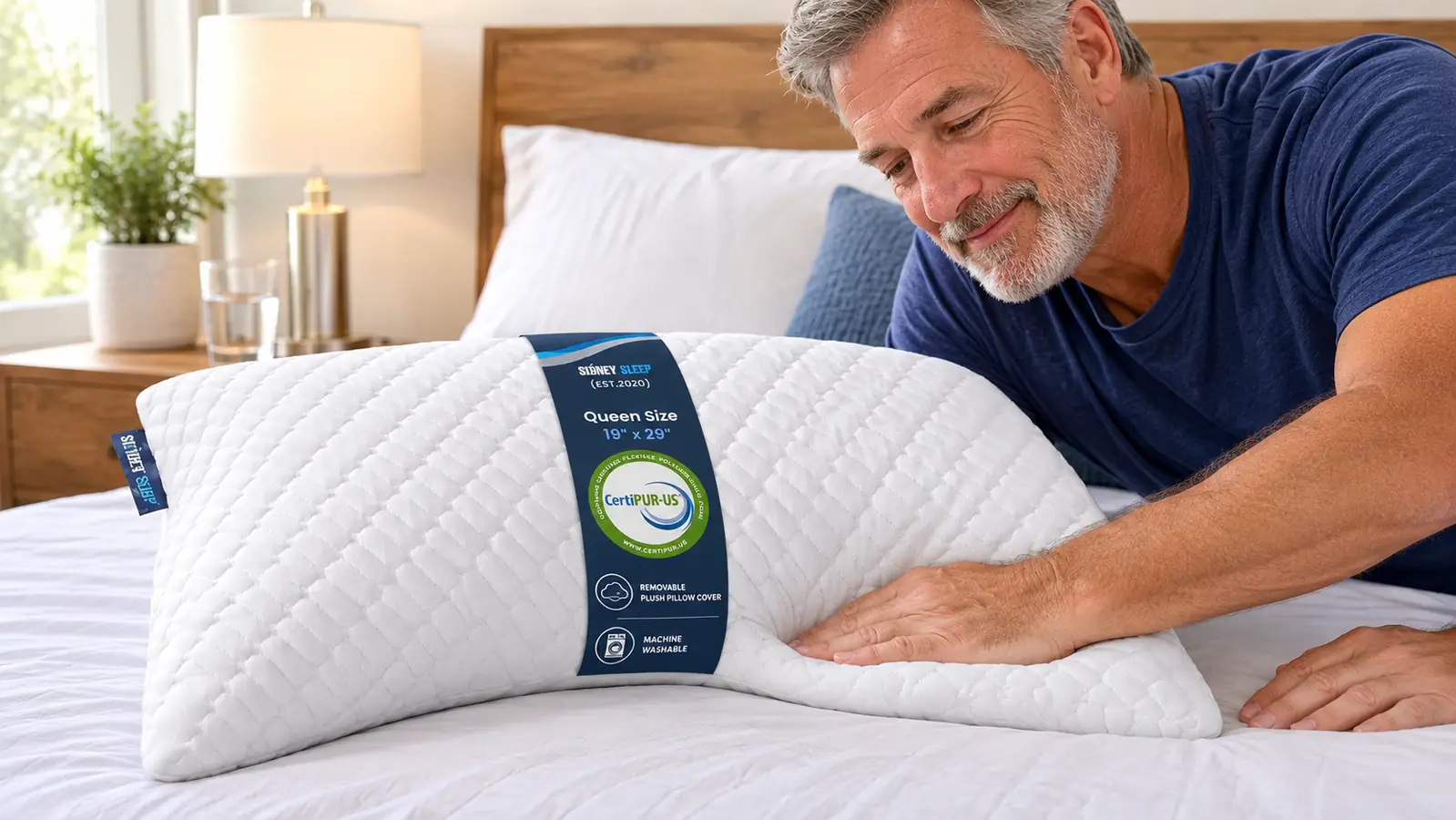
The argument for a curved pillow comes down to geometry, and the geometry is easy to picture. When you lie on your side, your head has to sit roughly level with the top of your shoulder. Otherwise your neck bends sideways and stays bent for eight hours. A flat pillow starts at one height and compresses to another the second your head lands on it. Mine was about four inches of fiberfill that flattened to two by midnight. The Sidney Sleep pillow has a curve built into the front edge, so your jaw and neck rest in the dip and your shoulder slides underneath the pillow instead of pushing your head uphill. That dip is the entire idea. Everything else is detail.
The fill is the part I did not expect to matter as much as it does. This pillow is filled with shredded foam rather than cut from one solid block, and the cover has room in it, which means you can take fill out. Over my first two weeks I removed roughly two handfuls, a little at a time, until the height finally matched the distance from my ear to the mattress. The extra fill went into the storage bag that came with the pillow, and that bag lives on the hall closet shelf. Nine months later I have not needed to put a single piece of it back.
The last thing it does better is stay put. A flat pillow ends up on the floor by morning because it has no shape to keep and nothing much to grip. This one is a queen, 19 by 29 inches, and the contour holds the pillow around your head instead of letting it slide out from under you. I turn over three or four times a night. I used to wake with my cheek on the bare sheet and one arm hanging off the edge. That stopped happening in the first month, and it has not started again.
Where a Flat Standard Pillow Wins
Now the honest part. I would still hand a flat pillow to a back sleeper without hesitating. My husband Dale is 63, a retired mail carrier, and he sleeps flat on his back and snores a little. He tried my pillow once, said it felt like a speed bump under his neck, and handed it back. He is right. The curve is built to fill the gap under a side sleeper's neck, and when you are on your back that same curve tips your chin toward your chest. A low, flat surface lets his head rest at the angle his back actually prefers.
Heat is the second place the flat pillow wins, and in a Missouri July that is not a small thing. Our bedroom sits on the upper level of a split-level house and it runs warm from June through September. Foam holds warmth. A contoured shape holds warmth too, because it wraps around your head instead of letting air move past it. There were nights in August when I turned the Sidney Sleep pillow over looking for a cooler side, twice in one night. The thin flat pillow never once made me feel like I was sleeping on a warm brick.
The third win is that a flat pillow asks nothing of you. No two-week adjustment, no handfuls of fill in a closet, no learning curve, no new bedtime routine. You buy it, you put a case on it, you sleep. That is worth something real, especially if you are outfitting a guest room or a camper or a first apartment, or if you simply do not want to think about a pillow ever again.
Night one with the Sidney Sleep pillow I woke up with a headache. Night fourteen I stopped thinking about it at all, which is the highest compliment I can give a pillow.
The two handfuls of fill I pulled out are why my neck stopped aching
It ships firm on purpose. Open the side zipper, take a little out at a time, and give it two weeks before you decide. Queen size, 19 by 29 inches, with extra fill and a storage bag in the box.
Amazon Check Today's Price on Amazon →How I Compared Them
Fair disclosure about the setup, because it matters more than any spec sheet. Both pillows were tested on the same queen mattress, which is about nine years old and on the firm side. The Linenspa gel topper arrived about eleven months ago, so my flat pillow spent most of its life on the bare mattress and only its last two months on the topper. The Sidney Sleep pillow has never known anything but the topper. If you are sleeping on a hard mattress with no topper under you, expect the curved pillow to feel firmer than I am describing, and expect to take out a little more fill than I did.
I did not run a sleep study and I am not going to pretend otherwise. I kept a note on my phone, a habit I picked up back when I was trying to figure out why I woke at 3 a.m. every single night. What I tracked was simple: did I wake with a stiff neck, did my right shoulder ache when I rolled onto it, and how many times did I get up. On the flat pillow, stiff neck five or six mornings a week. On the Sidney Sleep pillow, once or twice a week, and usually on a night when I had fallen asleep on the couch first and gone to bed at midnight.
The Two Weeks Nobody Warns You About
It ships firm. The listing says so and I read it and did not believe it. The first night my head sat too high, my neck felt craned forward, and I woke with a headache that lasted until lunch. My instinct was to box it up and send it back. What I did instead, mostly because a return is a chore, was open the side zipper and pull out one handful of fill. That helped a little. Two nights later I took out another. By the end of the second week the pillow had stopped being a project and started being a pillow.
This is the part that produces one-star reviews, and I understand why. If you judge a pillow by night one, this one fails the test. If you give it fourteen nights and a little patience with the fill, it does the job it was built to do. The storage bag matters more than it sounds like it would. It gives you a place to keep the fill you removed, so when the pillow softens in a year or two you can put some back instead of buying a replacement.

What Nine Months Has and Has Not Fixed
What it fixed: the 3 a.m. neck stiffness, mostly. The morning shoulder ache, mostly. The business of waking up with my cheek on the sheet because the pillow had migrated, entirely. What it has not fixed: my hips. They still ached where they pressed into the mattress, and no head pillow was ever going to solve that. The knee pillow I bought a month later did more for my hips than any pillow under my head could, which is worth knowing before you spend money in the wrong place entirely.
What has held up: the fill has not packed down into a brick the way my old fiberfill pillows did by the end of a year. I shake it out when I make the bed, which takes two seconds, and it comes back to shape. The seams have stayed put. What I would change: the curve is a commitment. If you like to sleep with your arm tucked under your pillow, the contour fights you a little, and I had to move my arm forward in front of my chest instead. That took a couple of weeks to get used to.
What My Back-Sleeping Husband Tells You
Dale is the control group in this house. He has slept on the same kind of flat pillow for years, replacing it whenever it went flat, and he has never once complained about his neck. When I asked him to try the Sidney Sleep pillow for a week, he made it two nights. His review: too much happening under his head. He wants a surface, not a shape.
That is the whole comparison in one marriage. Two people, same bed, same mattress, opposite answers. If you wake on your back, a flat pillow is not a compromise, it is the right tool for the job. If you wake on your side with a shoulder that hurts and a neck that cracks when you turn it, the flat pillow has quietly been the wrong tool for years, and you probably kept buying it because it was the one on the shelf.
Who Should Buy Which
Buy the Sidney Sleep curved pillow if you sleep on your side, if your shoulder is wider than your pillow is tall, and if you wake with a stiff neck more mornings than not. Buy it especially if your mattress is on the firm side, because that is where a flat pillow fails hardest. Buy it if you are willing to spend two weeks fiddling with fill and sleeping a little differently while you do. Skip it if you sleep on your back, if you want a pillow you never have to think about again, or if your bedroom runs hot and you have no fan.
Keep your flat pillow, or buy a fresh one, if you are a back sleeper, a stomach sleeper, or a person who wants the same experience on night one as on night four hundred. Keep it if you are setting up a guest room, because no guest should be removing handfuls of foam at eleven at night to get comfortable. There is no shame in a flat pillow. It is simply built for a different sleeper.
If you wake up on your side with a sore shoulder, start with the pillow
Nine months in, this is still the only head pillow on my side of the bed, and the spare fill is still in the closet bag. Give it the two weeks it needs before you make up your mind.
Amazon Check Today's Price on Amazon →