

For four summers running I woke at ten minutes to six, and it was never the alarm. Our bedroom faces east, and from late May through August the sun clears the neighbor's roofline before six. I would roll onto my left side, pull the sheet over my head, and lie there. I am 61, a retired dental hygienist, and a lifelong side sleeper. Twenty-nine years of leaning over patients left my right shoulder cranky, and a firm queen mattress that is nine years old does the rest.
I had already bought the topper, the curved pillow, the knee pillow and the body pillow. Each one helped. None of them stopped the light. By July I had added the MZOO 3D contoured sleep mask to the nightstand drawer, and that was the piece that finally let me sleep past six. So this is the order I would do it in if I started over: four light leaks and four fixes, and only one of them is a mask.
The piece I bought last and should have bought first
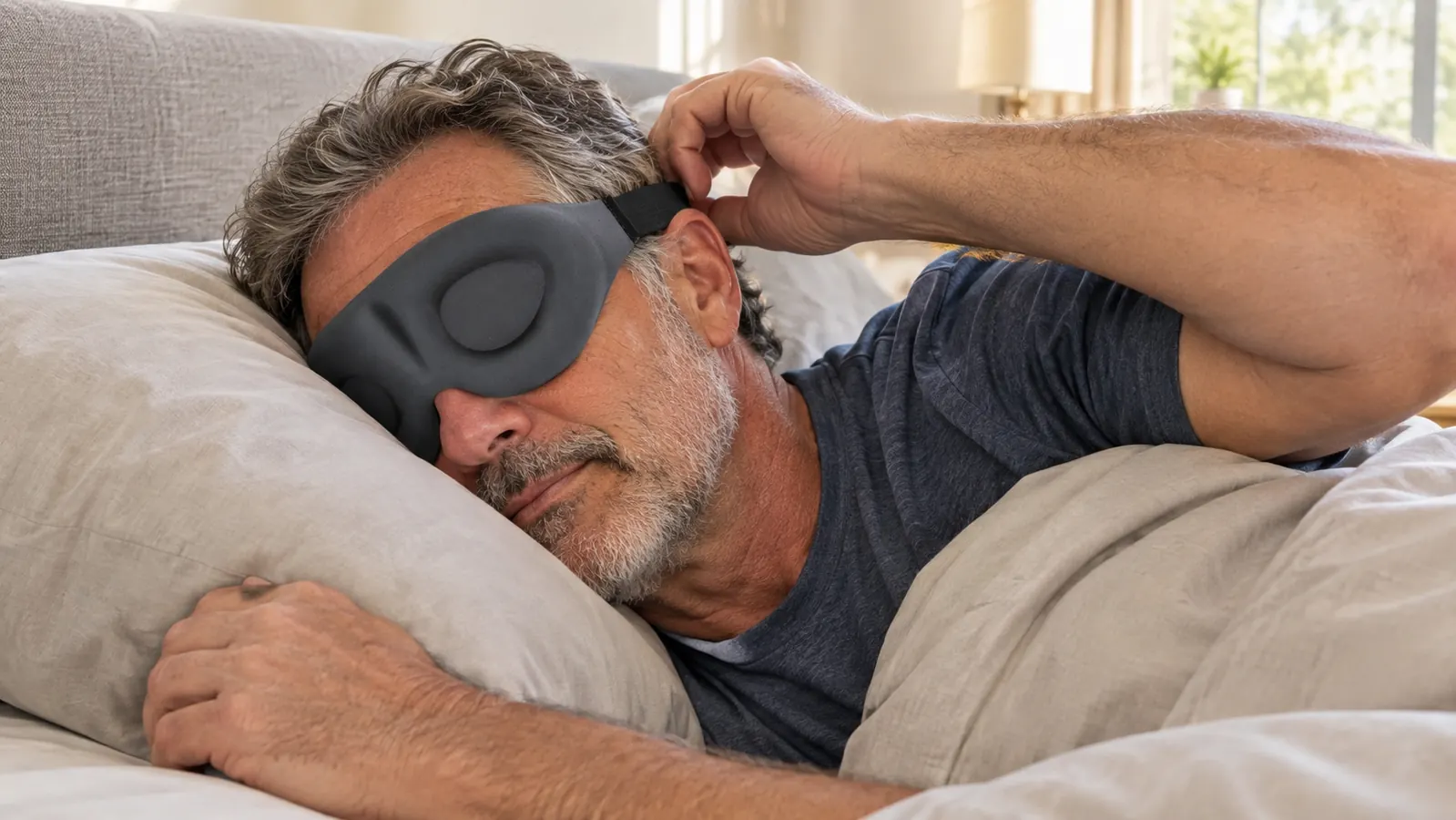
MZOO molded memory foam eye cups sit off the eye instead of on it, so a cheek pressed into a pillow does nothing to the lashes. Buckle closure at the back, 3.84 ounces, hand wash only.
Amazon Check Today's Price on Amazon →Step 1: Find out which light is actually waking you
Before you buy anything, spend three nights paying attention. Not sleeping better, just noticing. When you wake, do not reach for the phone. Lie still and look around the dark room the way you would look around an unfamiliar hotel room at two in the morning.
Most side sleepers I know blame the window, and it turns out to be something smaller. A cable box with a blue dot on it. A smoke detector blinking every thirty seconds. The gap under the bedroom door where the hallway nightlight leaks through. In our house it was two of those plus Dale's reading lamp, which is a genuine light source rather than a symbolic one, since he reads until eleven and I am usually asleep by nine-thirty.
Write down the time and what you saw, for three nights. That is enough to spot the pattern. Then rank the offenders by how much they actually disturb you, because you will fix them in that order and one or two of them are not worth fixing at all. A dim clock across the room bothered me for a week and then I stopped seeing it, and it has been there ever since.
One thing to rule out early: the light might not be the problem. If you wake at three with a stiff neck and aching hips no matter how dark it is, you are dealing with pressure and position, not photons, and no curtain on earth will help. In my case both things were true, which is why the topper and the pillows came first and the light work came second.
Step 2: Shut the window properly, not fashionably
Blackout curtains are the obvious answer and also where most people buy more than they need. The fabric matters much less than the edges. Light does not come through a good curtain, it comes around it: over the top of the rod, down both sides, and through the seam where two panels meet in the middle.
What worked in our bedroom was a plain blackout panel on a tension rod mounted inside the window frame, as close to the glass as the sill allows. That closes the top and both sides in one move, and it is simpler than a decorative set. A spring clamp on the center seam handles the last gap. If you already have curtains you like, a blackout liner hung behind them does nearly the same job with a fraction of the fuss.
Two things I got wrong. First, I hung the rod outside the frame the way the package suggested, and the light came around the ends for another month. Second, our bedroom runs warm in summer and a heavy panel traps heat against the glass, so I leave a two inch gap at the bottom for air. The sun clears that gap by the time it is high enough to matter. If your room heats up, fix the airflow before you chase the last inch of darkness.
If you rent, or if drilling into the window frame is not an option, the tension version needs no holes at all. It presses between the jambs and stays put. Mine has been up since spring and has not fallen once.
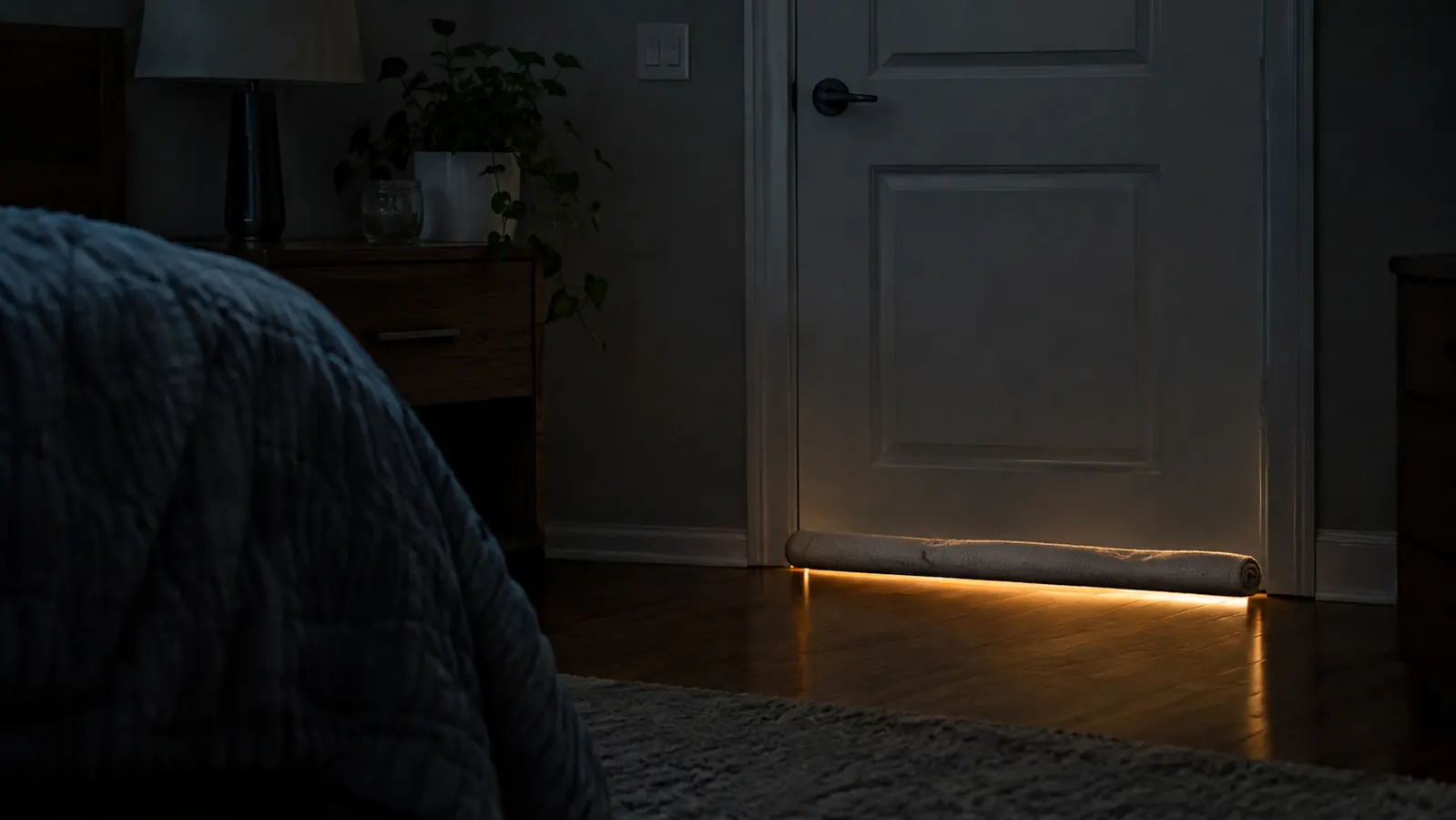
Then walk to the bedroom door and look at the bottom of it. If the hallway is lit, so is your floor. A rolled towel along the base of the door is ugly and it works. If you want it to look deliberate, a draft blocker does the same thing.
Step 3: Deal with the other person's light without a fight
Dale reads in bed with a lamp on his side. Asking him to stop would be asking him to change a habit he had before I met him, and I would lose that argument on the merits. So we moved the light instead of removing it. A smaller shade, a lower bulb, and the lamp pushed back toward his shoulder so the pool of light falls on his page and not across my face.
The bigger fix was timing. He reads until about ten now. I go up at nine-thirty. That trims the overlap to half an hour, which is a conversation, not a sacrifice. If your schedules collide more than ours do, a small clip light on the book does less damage to the person beside it than a table lamp does.
And then there is the part you cannot negotiate away. The summer sunrise at five-forty does not care whose turn it is to get up. That is the leak that sent me shopping in July, after the curtain was already up and the lamp was already moved, and it is the one that needed a different kind of answer.
There is a version of this where you buy a second lamp and a dimmer and spend a Saturday rewiring, and there is a version where you put a mask in a drawer. I did the first version for two months. The lamp still matters, but the mask is what made the difference between a five-forty wake-up and a six-forty one.
Step 4: Choose a mask that fits a face that is lying on its side
A flat fabric mask works fine when you are on your back. On your side it does something else. The pillow pushes the fabric against your eyelid, your lashes bend, and you either peel the thing off at two in the morning or lie there resenting it. The shape of the mask is the entire argument.
The MZOO mask is molded memory foam with contoured eye cups instead of a flat panel. The cups are 13mm deep and widened, so they sit off the eye rather than on it, with room to blink and room for lashes. When your cheek is pressed into the pillow, nothing is pressing on the eyeball. The nose area carries 22mm of padding, which matters more than it sounds. Light gets in around the nose before it gets in anywhere else, and that padding is what seals it.
The sides are the other half of the design. They are cut thin with a 15 degree curve, so the edge of the mask does not dig into your temple when your face is turned into the pillow. It weighs 3.84 ounces and measures 10 by 3.9 by 0.78 inches, which is to say it is gear, not a folded silk square. The closure is a buckle at the back, so it stays where you set it instead of sliding loose by morning.
Two honest notes. Memory foam holds warmth, and in a bedroom that already runs warm in July I noticed it for about a week before I stopped noticing it. And the cover is hand wash only, so it air dries overnight at best. I wash it on a Saturday morning, not at bedtime. At 4.6 stars across more than a hundred thousand reviews, I am clearly not the only person who decided the trade was worth it.
The first morning it worked, I woke at twenty to seven and had no idea what time it was. That had not happened in years.
Step 5: Fit it once, in daylight, before you need it
The first night with any new mask is a bad night if you fit it in the dark at nine-thirty with the lights already off. Do it at eight, sitting up, in a lit room, with the mirror on the dresser in front of you.
Set the buckle so the mask sits level, cups centered over your eyes, strap crossing the back of your head above the ears rather than across them. Tight enough that turning your face into the pillow does not shift it, loose enough that you are not aware of it. Then lie down on the side you actually sleep on and press your face into the pillow for a full minute. If the mask rides up toward your forehead, the strap is too low. If you can feel your lashes against foam, the cups are not centered.
Give it three nights before you decide anything. My first night felt strange, the second was neutral, and by the fourth I was putting it on without thinking about it. It lives in the nightstand drawer now, which is the highest honor a sleep accessory gets in this house.
And if you share a bed, tell the other person what you are doing. Dale spent the first week asking whether I could breathe. I could. He also stopped worrying about his lamp, which turned out to be the best part of the whole arrangement.
Clean it when it needs it, not on a schedule. Hand wash with a little mild soap, rinse, squeeze gently, and lay it flat to dry. Do not wring it out. The foam takes a set if you twist it, and then the cups do not sit the same way.
What Else Helps
Fix the small lights you stopped seeing. The clock radio with the red digits. The standby light on the television. The charging cable glowing on the floor. Electrical tape is undignified and effective. If you read on your phone in bed, the phone is a bigger light source than the window ever was, and no mask helps with a screen you are holding six inches from your face.
Keep the mask within reach without sitting up. Mine lives in the nightstand drawer, and when I wake at three because my hip is complaining, I roll onto my other side, put the mask back on, and I never have to find it in the dark.
Remember that light is only one of three inputs. The other two are pressure and temperature. On our bed that means the topper under the fitted sheet, the knee pillow keeping my top leg from rolling forward, and the body pillow in front of my chest so my right shoulder has somewhere to land instead of folding under me. All three of those work on the same night as the mask, and the mask is the easiest of them to change.
One more thing, if you travel. Keep a second mask in the bag. Hotel curtains are a joke, the hallway light under the door is worse than anything in your own house, and the MZOO case is stiff enough that it survives being packed next to a hair dryer.
Four light leaks, one afternoon, and a quieter six a.m.
The curtain and the lamp handled most of it. The mask handles the part no curtain can, the sunrise that arrives before you are ready to be awake.
Amazon Check Today's Price on Amazon →