Four months ago I bought the MZOO 3D Contoured Sleep Mask for two plain reasons. The sun clears the east window of our bedroom before six in July, and my husband Dale reads with his lamp on after I have already turned over. What I did not expect was that a molded mask would answer a question I had been carrying around for years. I am a lifelong side sleeper, mostly on my left, and every flat fabric eye mask I ever tried ended up somewhere near my ear by two in the morning. I had assumed that was a personal failing, some flaw in the way I turned over. It was not. It was the mask.
So here is the short answer. For side sleepers, the MZOO wins, and it wins for a reason you can feel on the first night. The eye cups are molded and deep, so the pillow pushes the mask sideways instead of pressing fabric into your closed eyelid. A flat fabric mask has nowhere to put that pressure. It lies across your face, and your cheekbone becomes the load-bearing point at three in the morning. That said, the flat mask is not a bad product. It is easier to wash, it is cooler on a hot night, and it packs flat. If you sleep on your back, or you only wear a mask for naps and travel, most of the MZOO's advantage quietly disappears. I will get to all of it.
| MZOO 3D Contoured | Flat Fabric Eye Mask | |
|---|---|---|
| Light blocking | Patented contoured cups seal around each eye, and 22mm of padding at the nose closes the gap at the bridge | Thin fabric rests on the face, so light creeps in at the nose bridge and along the cheeks |
| Pressure on the eyes | 13mm arc-shaped cups leave room to blink, and nothing touches the lashes | Fabric sits directly on the lids, so every blink drags the mask |
| Side-sleeping comfort | Sides curved at 15 degrees and cut thin, so the pillow pushes the mask aside instead of into your temple | A single thin layer means you feel the pillow through the mask |
| Fit and adjustment | Buckle closure, set once and forgotten | Elastic band slips on in the dark and forgives almost any head size |
| Heat on a warm night | Memory foam holds warmth against the face | A thin fabric layer breathes better |
| Care | Hand wash only, dry flat | Most go straight in the washing machine |
| Packing | Molded, 10 x 3.9 x 0.78 inches, so it takes up real room in a bag | Folds into a shirt pocket |
| Makeup and lashes | The 13mm cups leave makeup-safe space and room for lashes | Fabric rests against the lashes and takes eye cream with it |
| Best for | Nightly side sleeping at home | Naps, travel, and back sleepers who just want darkness |
Where the MZOO 3D Contoured Mask Wins
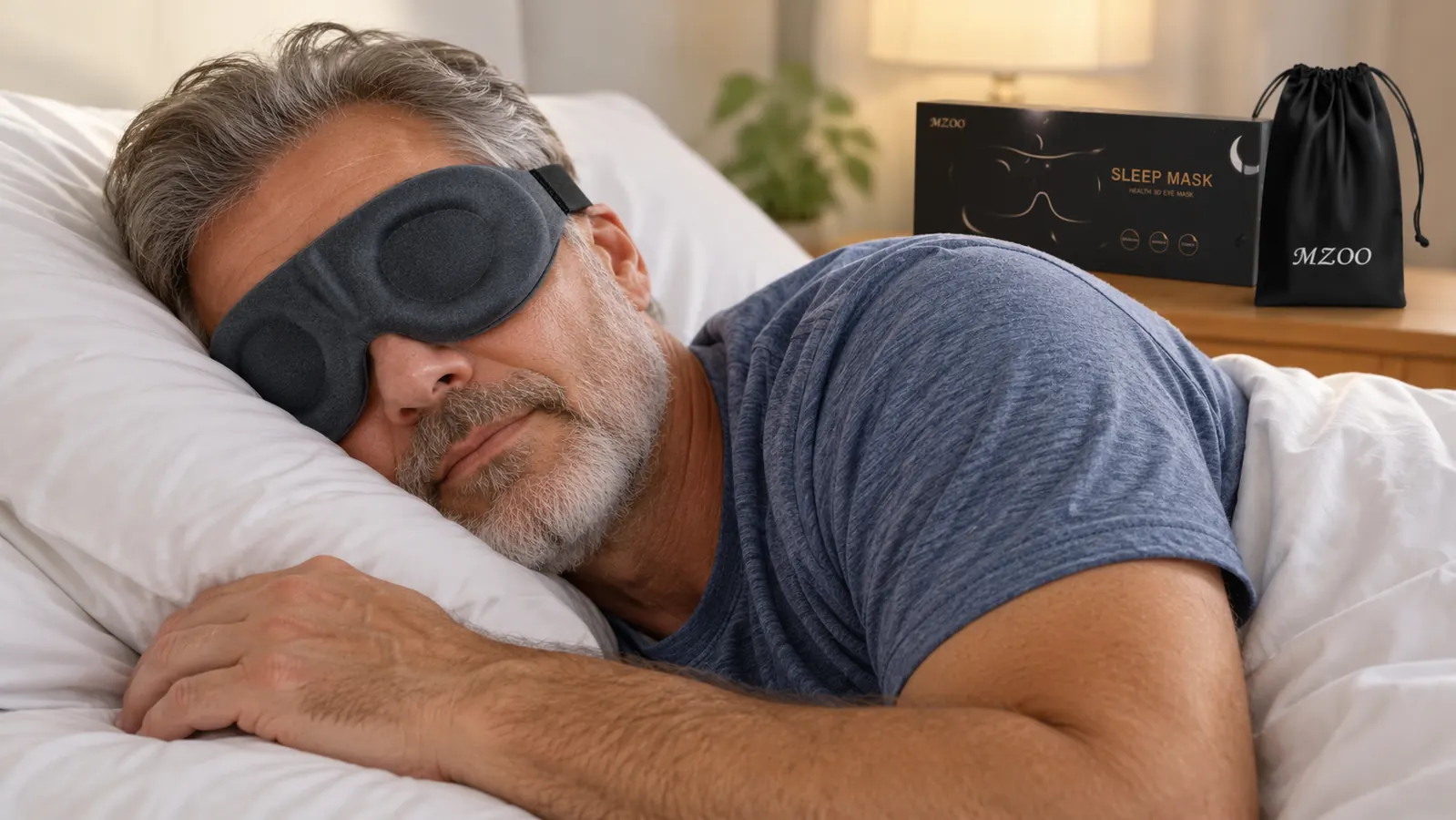
Start with the part your face actually touches. The eye cups on the MZOO are 13mm deep and arc-shaped, widened enough that my lashes have room and my eyelids can move without brushing anything. That sounds like a small thing until you have spent a decade blinking against fabric. On a flat mask, every blink drags the material across the lid, and by morning the mask has crept up toward your eyebrows. The molded cups hold the shape of the mask, so the only thing moving during the night is you. The seal is the second difference. There is 22mm of padding across the nose, and it sits exactly where a flat mask gives up, right at the bridge. My east window used to lay a bright stripe across my left eye at ten past five. It does not anymore.
The third difference is the one that matters most if you sleep on your side. The sides of the MZOO are curved at about 15 degrees and cut thin, so when my cheek presses into the pillow, the mask angles away instead of digging into my temple. The memory foam gives a little and then holds. With a flat fabric mask, the pillow and my cheekbone are fighting over the same thin layer, and my eyelid is caught between them. The buckle closure keeps the setting once you find it, which is a quiet benefit you only notice after a few weeks of not adjusting anything.
I set that buckle on a Saturday afternoon in daylight instead of guessing in the dark, holding the mask against my face and checking it in the bathroom mirror. It took four tries. My head pillow is a curved foam one that I filled and refilled over two weeks until the height finally matched my shoulder, and the thin side of the MZOO slides along that curve rather than catching on it. That was the part I had not anticipated. With the old flat mask, the band and the pillow grabbed each other every time I turned, and I would surface at three with the mask half off and the elastic twisted behind my ear. That stopped in the first week.
Where the Flat Fabric Eye Mask Wins
I am not going to pretend the flat mask has nothing going for it. It is cooler. Memory foam traps warmth against your face, and our upstairs bedroom runs hot from June through August. On the worst nights in July I took the MZOO off at two in the morning, not because it was uncomfortable, but because my face was warm. A thin fabric mask does not do that. It also goes in the washing machine, while the MZOO is hand wash only, which means a basin of cool water and a towel laid flat to dry.
Then there is the strap and the packing. A flat mask with an elastic band slips on in the dark in about a second. The MZOO uses a buckle, and the first three nights I was fiddling with it while Dale was already asleep and I was trying not to wake him. Once it was set, that was that, but there is a learning curve. And the MZOO is a molded object, roughly 10 inches by 3.9 by 0.78 and under four ounces, so it takes up real space in a carry-on. A flat mask folds into a shirt pocket. If your mask lives in a bag rather than on a nightstand, that difference decides the whole thing.
I have owned maybe four flat masks over the years, and they all died the same way. The elastic goes first. One of mine stretched enough that it slid up over my ears by midnight. Another came out of the dryer with the nose seam puckered, and after that it leaked a thin line of light straight across my left eye, which is worse than no mask at all because you keep expecting it to work. Replacing them was never painful, but four masks in a decade is its own kind of arithmetic, and it is the reason I finally tried something with a shape to it.
For side sleepers, the pillow stops winning
Molded eye cups, sides curved for a face that spends the night on a pillow, and 22mm of nose padding where light usually gets in. Four months in, mine still lives in the nightstand drawer.
Amazon Check Today's Price on Amazon →What Four Months Actually Looked Like
I bought the MZOO in July, which is the worst month to test anything that touches your face in a warm bedroom. The first week was a heat negotiation. I would put it on at ten and take it off around one. By the second week I had stopped noticing the warmth, mostly because the room cools after midnight and the foam had already come up to skin temperature. By the end of July it was staying on until morning. That break-in period is real and nobody mentions it.
I kept a note on the nightstand for the first three weeks, mostly out of habit from thirty years of writing things down at work. Week one read: off by one, sometimes earlier. Week two: off around two, once at three forty. Week three: on until the alarm. The room did not change during any of that. We run a box fan in the corner from June to September and it moves the air around but it does not cool foam that has been pressed against your face for four hours. What changed was that my skin stopped reporting on it, the way you stop noticing a watch by lunchtime.
The mornings were the part that changed. Dale reads until eleven or later with his lamp on, and I turn over around nine thirty. Before July I would lie there with a pillow over my head, which is not a real solution when you are 61 and your neck already complains about everything. Now I put the mask on and the lamp is simply not my problem. The same goes for the sun. Our house is a split-level and the bedroom takes the east light full in the face.
What it did not do is worth saying plainly, because I read too many reviews that promise the world. It did not make me sleep through the night. I still wake up around three on plenty of nights. My shoulder still aches if I stay on it too long, and the knee pillow and the body pillow still do their jobs. What the mask did was remove one small, stupid reason for waking up, which is the light, and that turned out to be worth more than I expected. Some nights that is the entire difference between lying there and going back under.
It did not make me sleep through the night. It removed the light, and some nights that is the entire difference.
How the Two Masks Fail Differently at Three in the Morning
Every sleep mask fails eventually. The question is how. A flat fabric mask fails by migrating. It rides up as you turn, the elastic loosens with washing, and the nose gap lets a sliver of light in exactly where your eye is. If you wear eye cream, the fabric also takes it, which is how a mask ends up smelling like last week. The MZOO fails differently. It does not migrate and it does not leak, but it is warmer and it is fussier, and hand washing means you cannot throw it in with the towels on Sunday. Mine gets washed about every ten days and takes a full day to dry flat on the counter.
That hand washing is the one chore I have not made peace with. I fill the bathroom sink with cool water and a drop of mild soap, work it around the foam with my fingers, rinse it, and press it between two towels. Then it lies flat on the kitchen counter overnight. Wash it on a Sunday morning and it is dry by Monday night. Wash it at nine in the evening and I am going to bed without it, which I have now done twice. A flat mask goes in with the towels and comes out warm twenty minutes later. That is a real difference in how often the thing actually gets cleaned, and I suspect my flat masks were washed more often than this one.
There is also the fitting question. The buckle has one correct setting for your head, and if Dale ever borrowed it, which he has not, he would have to find his own. A stretch band forgives that. So if two people in the house share a single mask, the flat one is easier. If one person owns it and sets it once, the buckle is the better system, because an elastic band relaxes over months and a buckle does not.
Who Should Buy Which
Buy the MZOO if you sleep on your side, if you have ever woken up with a mask pushed up onto your forehead, or if the light in your room comes from a direction you cannot control. It is also the better pick if you wear eye makeup to bed, or if your lashes are long enough that fabric against them is a nuisance, because the 13mm cups leave room to blink. It costs more than a flat mask, it is warmer, and it needs hand washing. Those are real costs and I would not pretend otherwise.
Stay with a flat fabric mask if you sleep on your back, if your bedroom runs hot and you have no air conditioning, or if your mask mostly travels. It is also the sensible choice if you want something you can machine wash without thinking about it, or if you share it. A flat mask with a soft band does one job and does it without fuss. It is a fine second mask to keep in a Dopp kit. It is just not the one I reach for on a Tuesday night when I need to be asleep by ten.
One more thing worth weighing, because it surprised me. The mask did not fix my neck, and no mask will. My right shoulder still aches from all those years leaning over patients, and what helped that was the foam topper on the mattress and the curved pillow, not this. What the mask fixed was narrower and more specific: the light on my face, and the pressure on my eyelid when my cheek was on the pillow. If your problem is your shoulder, spend your money on a pillow. If your problem is that you are awake at five because the sun is on your face and Dale is still reading, this is the right purchase.
Four months in, it still earns its drawer
The molded cups block the light, the curved sides stop the pillow from pressing into your temple, and the nose padding closes the gap. If that describes your nights, this is the version worth trying.
Amazon Check Today's Price on Amazon →