

Three in the morning is its own kind of tired. For most of my working life I woke at that hour with my right shoulder complaining and my hip aching where it pressed into the mattress, and then I would roll to the other side, punch two pillows back into shape, and lie there doing arithmetic on how many hours were left before the alarm. Thirty years of leaning over patients in a dental chair does something to a shoulder. Sleeping on my left side, which is the only way I have ever really slept, did the rest.
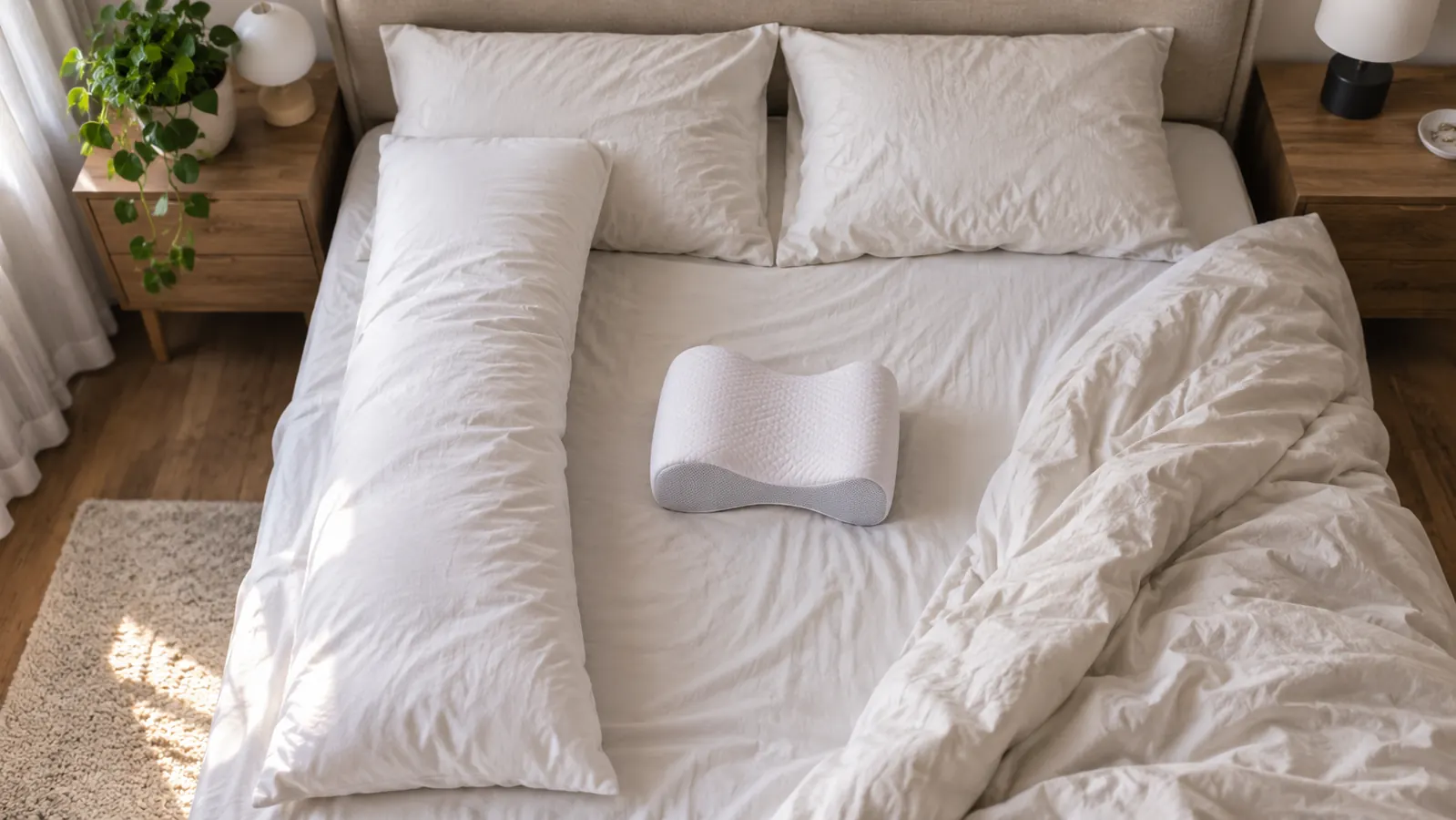
What I tried first was more pillows. Two stacked under my head, a folded blanket wedged under my ribs, a rolled towel pushed under my hip. All of it worked for about ninety minutes and then slid somewhere useless. What finally helped was a long pillow I could hug, so my top arm had somewhere to land instead of folding across my chest and dragging the shoulder forward. About five months ago I started sleeping with the Utopia Bedding full body pillow, the 20 by 54 inch size, and the useful part is not that it is fancy. It is that it stays where I put it. It runs the length of my edge of the bed, on the side away from Dale, and it does one job well.
The pillow that finally gave my shoulder somewhere to land
20 by 54 inches, soft polyester fill, spot clean only. It will not rescue a worn-out mattress, but it is the change I wish I had made ten years earlier.
Amazon Check Today's Price on Amazon →Step 1: Put it in front of you, not behind you
When you sleep on your side, your top arm has nowhere to go. Watch yourself for one night and you will see it. The arm ends up folded across your chest, or tucked under your cheek, or hanging over the edge of the bed, and by hour four the shoulder has rolled forward and the joint is unhappy about it. A long pillow in front of the chest gives that arm a shelf. I hug the upper half of mine, forearm draped across it with my hand near the top end, and my shoulder stays square instead of collapsing inward.
Where the pillow sits matters as much as how you hold it. Mine lies lengthwise along my side of the bed, top end about level with my collarbone, the rest of it running down past my hip. Too high and you fight it with your chin all night. Too low and your arm slides off the end and you are back where you started. Move it two or three inches at a time over the course of a week. You will know when it is right because you stop noticing it is there.
I measured mine against myself before the first night, which sounds fussy and took four minutes. Standing up, the top of the pillow came to my collarbone and the bottom end landed just below my hip bone. That is the whole test. If yours reaches your knees, you have it too far down and your arm will wander off the top. If the top end sits under your chin, you will spend the night pushing it away. Forty-one years in the same house and I still had to get out a tape measure to convince myself a 54 inch pillow was not too long for a queen bed. It was not. It covered about two thirds of my half and left room for me to roll onto my back for ten minutes without shoving it onto the floor.
One practical thing nobody mentions: it takes up real estate. Twenty inches is a fifth of a queen mattress, and if you share a full-size bed, measure the width before you commit. Dale sleeps on his back and does not want a long pillow anywhere near his side, so mine lives on my half and the line down the middle of the bed is understood. If you are the kind of sleeper who sprawls across the whole mattress at two in the morning, this arrangement will annoy you for the first week.

Step 2: Decide which joint the pillow is actually for
Here is the mistake I made for months. I expected one pillow to fix my knees and my shoulder at the same time, and it did neither job well. The long pillow is for your arm and shoulder and the front of your chest. The space between your knees needs something shorter, firmer and easier to keep in place, because a 54 inch pillow between your knees will be shoved onto the floor by midnight. The Utopia Bedding pillow is five feet long, which makes it a clumsy fit for a job that only needs about eighteen inches of support.
I sleep with a knee pillow between my knees every night, and it kept my top knee and hip from rolling forward from the very first night. The long pillow came later and took over the arm job. Two pillows, two jobs, and neither one has to be rearranged four times a night. That division of labor is the single biggest reason my mornings changed.
I learned that the hard way in early summer. For about three weeks I tried using the long pillow for everything, folded in half and shoved down between my knees, and it was miserable. Folded polyester is lumpy, it slid out from between my legs every time I turned, and it left the top end of the pillow bunched under my arm in a way that made my shoulder worse, not better. Dale found it on the floor three mornings running. Once I gave up and put the knee pillow back where it belonged, the long pillow went back to doing the one job it is actually shaped for, and both stopped being a nuisance.
If you can only buy one thing right now, buy for the joint that actually wakes you up. If it is your hip, start with the knee pillow. If your top shoulder is what throbs when the alarm goes off, start with the long pillow and use a spare bed pillow folded in half between your knees until you get around to the other one.
Step 3: Give it two weeks before you judge it
A new sleep position feels wrong before it feels normal. My first three nights I was aware of the pillow the whole time, the way you are aware of a new pair of shoes. That is not a sign it is failing. It is a sign you have changed something your body has done the same way for decades.
Polyester fill is soft and lofty, and it will settle. I fluff mine in the morning the way you would fluff any pillow, and I shake it back to full length before I get in. If the middle goes flat toward the end of the night, that is what a soft fill does. Fluff it, turn it end for end once a week, and it comes back.
I kept a note on the back of an envelope for the first month, which is the sort of thing a retired hygienist does, and I am glad I did, because my memory of that stretch is worse than the record. Week one: woke twice a night, shoulder quiet but I was conscious of the pillow. Week two: woke once, around four, and went back to sleep without getting up. Week three: two full nights without waking, which had not happened in years. The number that mattered to me was not how I felt on any single morning. It was how many mornings in a row I got up without reaching for my own shoulder first.
What I noticed at the two week mark was not dramatic. I stopped waking at three. I still wake sometimes, because I am sixty-one and I drink too much iced tea after dinner, but the shoulder was quiet when I did. The hip ached less too, though I would be lying if I gave the pillow all the credit for that. The topper had already done a lot of that work eleven months earlier, and I would not want anyone reading this to buy a pillow expecting it to fix a mattress.
The knee pillow handles my knees. The long pillow handles my shoulder. Asking one pillow to do both is how I lost a year.
Step 4: Deal with the heat before it becomes an excuse to quit
Our bedroom sits on the east side of a split-level house and it runs warm from June through September. A long pillow pressed against the front of your body is a lot of surface area. The listing calls the fabric breathable, and it is, but a 54 inch pillow against your chest in July is still a lot of pillow. If you run hot, plan for it instead of giving up in August and blaming the pillow.
August was the test. There was a stretch of about nine days where the upstairs never got below seventy-eight degrees overnight, and the first two nights I woke up with the pillow damp against my chest and seriously considered putting it in the hall closet until October. What changed my mind was moving it, not abandoning it. I found that if I let the pillow sit two or three inches forward and rested my forearm across the top of it rather than pulling it tight to my body, the air moved between us. Same shoulder support, half the heat. The other thing was the pillowcase. The one I started with was a heavier weave, and swapping to a plain cotton case made a difference I could actually feel by the second night.
Three things helped me. I keep a long cotton pillowcase on mine rather than sleeping against the bare fabric. I rotate the pillow end for end every few days so the cool side comes around. And on the worst nights I let it sit a few inches away from my chest and rest my forearm on it rather than hugging it tight, which keeps the shoulder supported without trapping all that warmth against me.
Step 5: Keep it clean without washing the life out of it
The care instructions say spot clean, and that is not a suggestion you can ignore. I have spot cleaned my Utopia Bedding pillow three times since early summer and it has never been in the washing machine. A dab with a damp cloth and a little mild soap, then air dry, handles the ordinary stuff. Do not scrub at it, because scrubbing works the fill into clumps you will not get out.
I know all of this because I ruined a pillow once by ignoring it. Years ago I put a polyester bed pillow through a hot wash and a hot dry, thinking I was being thorough, and it came out in a shape I can only describe as a sack of gravel with a bend in the middle. The fill had balled up in the corners and no amount of shaking fixed it. I have not made that mistake since, and I am not about to make it with a pillow that is five feet long, where the same mistake would be five times as expensive to replace.
The pillowcase does the heavy lifting. I change and wash mine weekly along with the sheets, which means the pillow itself barely needs anything. If you sleep with the pillow against bare skin, expect to spot clean more often, and expect the fabric to show it.
What Else Helps
The long pillow is one piece of a setup, and I would be overselling it to pretend otherwise. The biggest change came first, about eleven months ago, when we put a two inch gel memory foam topper across the whole queen mattress. It lies under the fitted sheet, so Dale sleeps on it too, and it meant my hip and shoulder stopped pressing straight into a nine-year-old firm mattress. The body pillow came months later and built on that. If your mattress is hard and old, start there. On my bed the Utopia Bedding pillow is the piece that finished the job, not the piece that started it.
My head pillow changed too. About nine months ago I switched to an adjustable curved pillow and took out roughly two handfuls of fill over the first two weeks until the height matched my shoulder width. Sleeping on your side with a head pillow that is too thin is what gave me the stiff neck in the first place. Add a sleep mask if morning light or a reading lamp is waking you, and keep the room as cool as you can stand it. None of it is complicated. It is just a stack of small fixes that add up to a night you do not remember.
If I had to rank them by how much they changed my mornings, the topper is first, the head pillow is second, and the long body pillow is third. That sounds like faint praise and it is not meant to be. Third place out of five is what stopped the three in the morning wake-ups, and it is the cheapest of the three to try.
Five months in, it is the pillow I reach for without thinking
Twenty inches wide, fifty-four inches long, soft fill, spot clean care. If you sleep on your side and your top shoulder is the thing that wakes you, this is where I would start.
Amazon See the Utopia Bedding Body Pillow on Amazon →