

A firm mattress is a strange thing to complain about. You buy one because someone tells you it will last, and it does last, and then for eight hours a night it pushes back against your hip and your shoulder like it has something to prove. I am a lifelong side sleeper, mostly on my left. My right shoulder has been sore since my dental hygiene years, when I spent whole days leaning over patients, and for a long time I woke around three in the morning with a stiff neck and hips that ached wherever they pressed into the mattress.
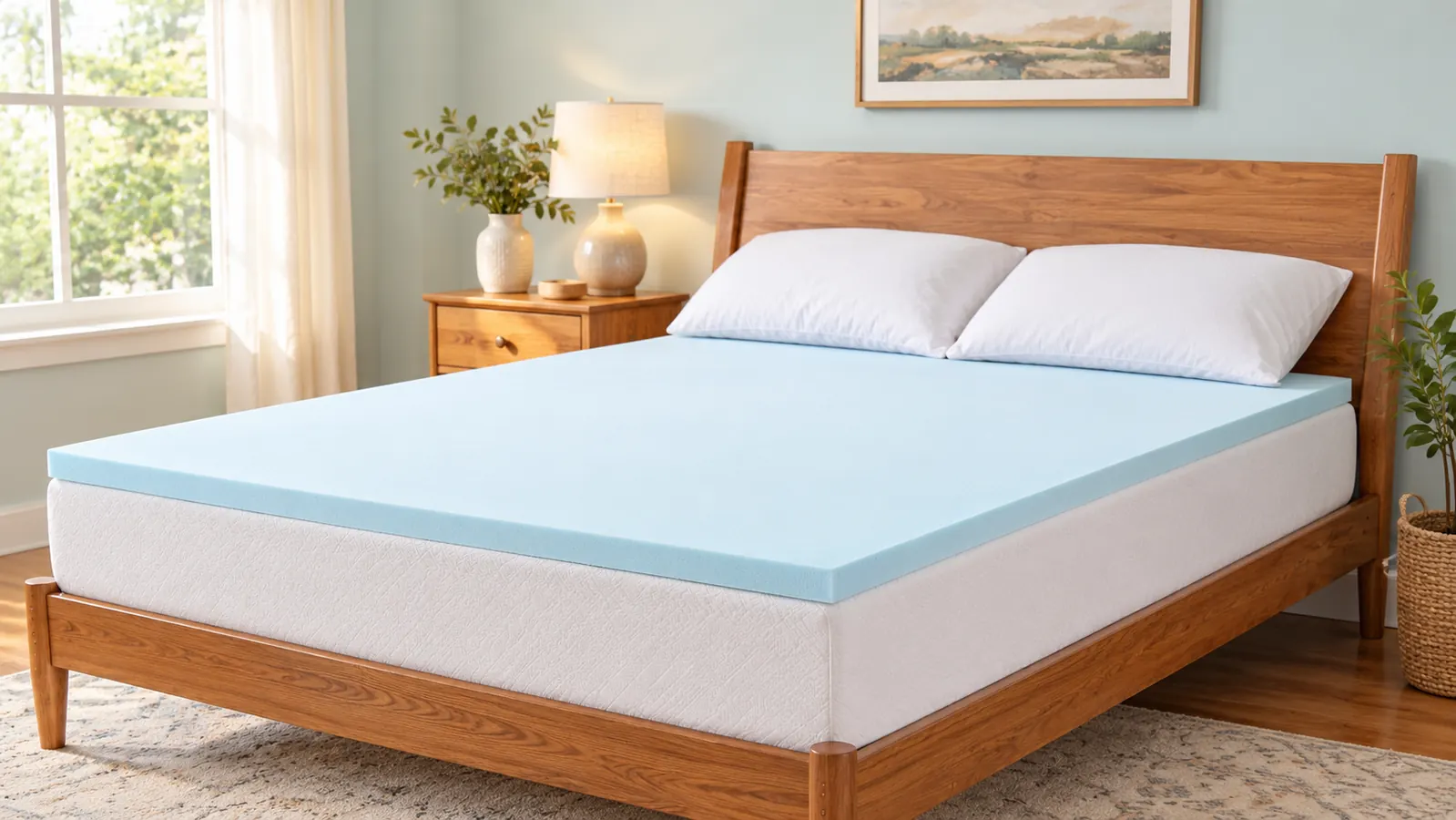
For months I assumed the answer was a new mattress. I looked at them, I read the labels, I sat on a few in a store with my shoes off, and then I went home and slept on mine. What actually helped was smaller than that. I softened the bed I already had. My queen is about nine years old and still very much on the firm side, and last December, about eleven months ago, I put a two inch Linenspa gel memory foam topper on it, under the fitted sheet. That is the change that stopped the three a.m. wake-ups, and it cost me a fraction of what a new bed would have.
The two inch layer that ended my 3 a.m. wake-ups
Plush gel memory foam in queen size, infused with a cooling gel, and it arrives compressed and rolled so you can get it up the stairs yourself. Mine has been under the fitted sheet for eleven months and has not come off once.
Amazon Check Today's Price on Amazon →Step 1: Make Sure the Mattress Is Worth Softening
Before you spend anything, work out whether your mattress is tired or actually broken. Those are two different problems and only one of them responds to a topper. Mine was tired. Nine years of nightly use had packed the foam down a little, but the surface was still flat. I laid a long level across the part of the bed where my hips land and looked for daylight underneath, and there was barely any gap. That told me the mattress still had a flat, supportive surface to build on.
Now press around with the flat of your hand, especially where your hip and shoulder land. If you can feel a hollow, or if the edges collapse when you sit on them, a topper will simply follow the hollow down and you will have spent money to make a bad bed slightly taller. Check the foundation too. A queen sitting on a tired box spring can feel firm and dead at the same time, and no layer of foam rescues a base that has given up. If you can, get someone to lie on the bed while you look at the frame from the side.
If the mattress is genuinely sagging, replace it. I know that is not the answer anyone wants at the start of an article about softening what you already own. But it is the honest one, and it will save you from layering good foam onto a collapsed surface.
Step 2: Choose a Depth That Softens You Without Swallowing You
Topper depth is most of the decision. Two inches adds a cushion between you and the mattress. Three inches adds more cushion and more sink, and for some side sleepers that extra depth is exactly right. For me, on a firm queen, two inches was enough and I would have been nervous about three. When the foam under you is too deep and too soft, your hips drop lower than your shoulders, and then your lower back spends the night in a curve it did not ask for. You wake up with a different ache in a different place and assume toppers do not work.
Here is the test I settled on. You want your shoulder and your hip to sink in by roughly the same amount. If your shoulder stops sinking and burns, the surface is too firm. If your hip keeps sinking and your low back is stiff by morning, the surface is too soft. The Linenspa topper comes in a two inch plush and a three inch that is plusher still, and the choice between them is really a choice about how much of your mattress you want to stop feeling.
One honest note about heat. The topper is infused with a cooling gel meant to capture and distribute heat, and I do think it sleeps cooler than plain memory foam. It still sleeps warmer than a bare cotton mattress. Our bedroom is in a split-level house and it runs warm in summer, and there were nights in July when I noticed the difference. If you run hot, plan for that rather than being surprised by it in the middle of the night. Lighter bedding and a cooler thermostat do more than you would think.
Step 3: Unroll It, Air It Out, Let It Plump
The Linenspa topper arrives compressed and rolled. You open the package, unroll it, and watch it come back up. Mine took most of a day to reach its full two inches, and it looked thin and sorry for the first few hours, which is normal and not a reason to send it back. Do not judge the height until tomorrow.
It also smelled. Not strongly, and not for long, but it was there. I unrolled it on the guest room bed and left the window cracked for about two days, and after that I could not smell it at all. If you are sensitive to that sort of thing, unroll it in a spare room rather than making your bed with it the same afternoon and regretting it at bedtime.
Then it goes under the fitted sheet, across the whole mattress, not just your half. Mine has been there ever since and it does not shift around. Care is spot clean only and it is not water resistant, so a mattress protector over the top is worth the small trouble, especially if you drink water in bed or run hot at night. Deep pocket sheets help as well, because two inches changes the fit more than you would expect.
Two inches is not a new mattress. It is enough that my hip stopped pressing straight into nine year old foam, and that turned out to be the whole problem.

Step 4: Rebuild the Pillows Around Your Shoulder and Hips
A topper fixes the surface. It does not fix the two places a side sleeper actually hurts, which are the shoulder folded under you and the top hip rolling forward. Adding two inches also changes the height of your head, and my old pillow was suddenly too low, which surprised me. That is how I ended up with an adjustable curved pillow I could take fill out of, a couple of handfuls over the first two weeks, until the height matched my shoulder again.
A knee pillow came next, and from the first night it kept my top knee and hip from rolling forward and dragging my lower back along with them. A body pillow came later, in early summer, and it does a different job entirely. I hug the upper half of it in front of my chest so my right arm and my sore right shoulder rest on something instead of folding forward all night. The knee pillow still does the knee job. They are not the same pillow.
You do not need all of that on day one. Start with the topper, sleep on it for a week, and notice where you are still sore in the morning. Then fix that one spot. Pillows are cheaper than mattresses and a great deal easier to change.
Step 5: Give It Two Weeks, Then Adjust
Memory foam softens as it warms up, so night one is not the night to judge. Give it a week, and honestly two, before you decide. My first three nights felt strange in a good way, like the mattress had stopped arguing with me. The real test was whether I was still waking at three, and by the second week I mostly was not.
If it ends up too soft, that is a real possibility and I will not pretend otherwise. Some people go from a mattress that is too firm straight to a bed that is too soft, and end up with a low back ache instead of a shoulder ache. If that happens, a thinner topper or a firmer mattress pad underneath can bring some of the support back. It is also worth rotating the topper head to foot every few months so you are not always compressing the same patch.
And be honest about your sleep position. If you roll onto your back halfway through the night, some of your morning stiffness is a pillow problem rather than a mattress problem. I sleep on my left side almost all night, which is why the shoulder and the hip were the only two things I had to solve. Your list may be longer.
What Else Helps
Room temperature matters more than I expected. A warm bedroom makes foam under you feel softer and makes you notice it more. We keep the thermostat low and I switched to a lighter blanket in summer, and that did as much for my three a.m. wake-ups as anything else on this list. If you share the bed, as I do, the topper goes under the sheet across the whole mattress, so your partner ends up on it too. My husband Dale sleeps on his back and snores a little, and he has never once mentioned the topper, which from him is a five star review.
Light is the other one. Our bedroom faces east, and in July the sun came through that window before six. I added a contoured sleep mask with molded eye cups that do not press on my eyes when my face is turned into the pillow, and it lives in the nightstand drawer now. Between the topper, the pillow arrangement, the cooler room and the mask, a pile of small fixes added up to something that finally felt like sleep.
None of it is dramatic. That is rather the point. A softer surface, a shoulder that is supported, hips that are not pressed flat into foam, and a room cool enough to stay asleep in. You are not looking for a transformation, just for the 3 a.m. wake-up to stop happening.
Start with the layer that does most of the work
The Linenspa 2 Inch Gel Memory Foam Mattress Topper is the piece underneath everything else. Plush, queen size, a three year manufacturer warranty, and it arrives compressed and rolled. Eleven months in, I have not once wanted to take it off.
Amazon Check Today's Price on Amazon →